

Best Roofing Materials in Kenya (2026): The Complete Guide to Choosing, Costing, and Installing Your Roof
The best roofing materials in Kenya range from corrugated mabati at KES 520 per metre to premium stone-coated tiles at KES 2,800 to 3,500 per square metre. This guide tells you exactly which material fits your budget, your climate, and your building - so you only have to decide once.
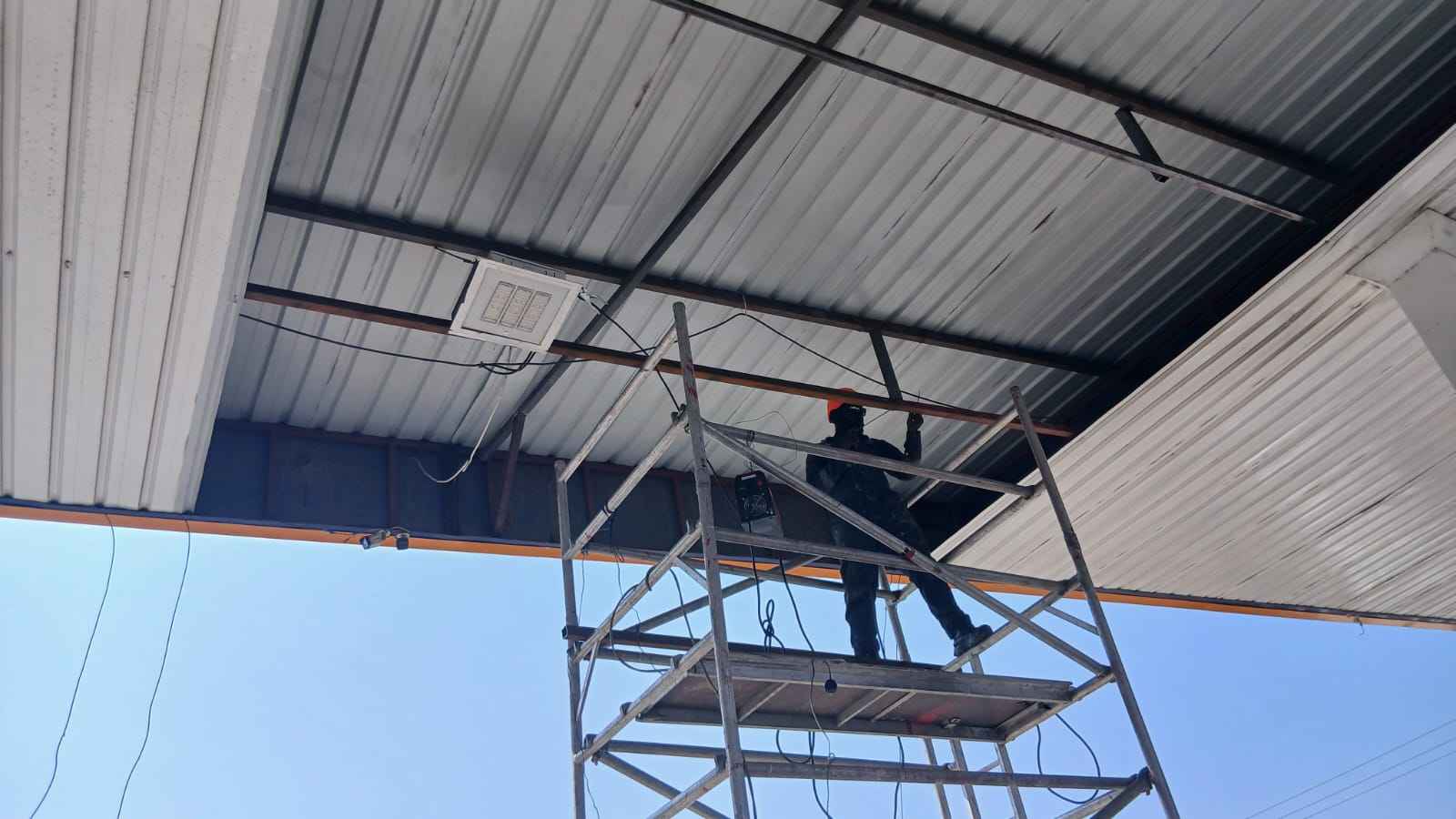
Choosing the wrong roofing material in Kenya is expensive. This guide helps you choose right the first time.
Your roof is the single most exposed part of your house. It faces the equatorial sun in Nairobi, the salt air in Mombasa, the heavy rains in Kisumu, and everything in between. A roof that suits one climate can fail in another. A material that looks affordable today can cost twice as much in replacements and repairs over ten years.
Most guides online tell you what the options are. This guide tells you which one to actually pick - based on your location, your budget, and how long you plan to own the building. We have installed roofs across Kenya at Universal Innovations and Industrial Ltd and this is the honest advice we give every client before we touch a single sheet.
Quick Verdict - Best Roofing Material by Category
From KES 580/m. Gets the job done. Upgrade the gauge, not the profile.
From KES 720/m. Clean look, solid durability, works on most roof pitches.
KES 2,800 to 3,500/m². Lasts 40 to 50 years. Lowest lifetime cost.
KES 1,400 to 3,200/m². Salt-proof, 50 to 70 year lifespan. Built for Mombasa.
50-year warranty available. Looks like clay, weighs a fraction of it.
Up to 70 years. Outlasts the timber below it. Worth the extra weight planning.
- How to Choose a Roofing Material in Kenya
- Corrugated Iron Sheets (Mabati)
- Box Profile Mabati
- Stone-Coated Roofing Tiles
- Clay Roofing Tiles
- Concrete Roofing Tiles
- Versatile and Roman Tile Profiles
- Roofing Shingles
- 2026 Roofing Material Prices in Kenya
- Which Material for Which Climate in Kenya
- Lifespan and Lifetime Cost Comparison
- How to Decide - A Simple Framework
- Roofing Installation - What to Expect
- Frequently Asked Questions
How to Choose a Roofing Material in Kenya
Before looking at any specific material, answer these four questions. They will eliminate most of the options and point you clearly at one or two materials worth comparing in detail.
- What is your roof pitch? Flat or low-pitch roofs below 15 degrees need waterproofing membranes or box profile, not tiles. Steep-pitch roofs above 25 degrees can carry the full range of materials including clay and concrete tiles.
- Where is the building located? Coastal areas within 15km of the ocean need corrosion-resistant materials. Salt air destroys standard galvanized mabati within five years. Highlands and equatorial zones have different challenges - heavy rain and UV intensity rather than salt.
- How long do you plan to own or use the building? For a ten-year rental property, corrugated G28 mabati makes economic sense. For a permanent family home, the maths shift strongly toward stone-coated tiles or clay that last 40 to 70 years without replacement.
- What can your roof structure carry? Clay and concrete tiles are heavy - they require a properly designed and sized timber or steel truss. Standard light trusses built for mabati cannot carry clay tiles without reinforcement. Your contractor or structural engineer needs to confirm this before you choose a heavy material.
Once you have those four answers, the choice becomes straightforward. The sections below cover each material in detail so you can make a confident final decision.
Corrugated Iron Sheets (Mabati) - The Affordable Standard
Corrugated Mabati
Corrugated mabati is the most widely used roofing material in Kenya, and for good reason. It is readily available from every hardware across the country, it is lightweight and easy to install, and it gets a building covered quickly and affordably. The wavy corrugated profile adds structural rigidity and allows rainwater to run off quickly.
The key variable is the gauge. Gauge 30 is thin and suited to temporary structures - it dents, bends, and corrodes faster. Gauge 28 is the standard for most permanent residential buildings in Kenya and is the minimum we recommend for any home you plan to live in for more than five years. Gauge 26 is thicker and more rigid, used on commercial buildings and exposed locations where hail, falling branches, or heavy impact are a risk.
The coating matters as much as the gauge. Unpainted galvanized sheets are the cheapest option but have the shortest lifespan. Pre-painted polyester coated sheets last significantly longer and come in a range of colours. Aluzinc or zinc-aluminium coated sheets offer the best rust resistance and are the right choice for areas with high humidity.
- Lowest upfront cost available
- Widely available everywhere in Kenya
- Lightweight - no heavy trusses needed
- Fast to install
- Easy to repair or replace individual sheets
- Noisy in heavy rain without insulation
- Gets hot in direct sun - affects interior temperatures
- Standard galvanized sheets rust in coastal areas
- Shorter lifespan than tiles if low gauge used
- Seen as less prestigious on high-end homes
Box Profile Mabati - The Modern Mid-Range Choice
Box Profile Mabati
Box profile mabati has a flat, squared channel profile that gives a cleaner and more contemporary look than corrugated sheets. It is the dominant choice for modern urban homes, commercial buildings, schools, and light industrial structures across Kenya because it combines good looks with practical performance.
The flat wide spans of box profile shed water effectively even on lower roof pitches, which makes it versatile for a range of architectural designs. It is available in Gauge 30, 28, and 26, with the same guidance on gauge selection applying as with corrugated sheets. For a permanent home, go with Gauge 26.
Box profile is the sweet spot between corrugated mabati and tile roofing. It costs more than corrugated but is significantly cheaper than stone-coated tiles or clay, while delivering a noticeably more finished appearance. For rental developments, commercial units, or any project where budget discipline is real but you want a professional result, box profile is usually the right answer.
- Clean, modern appearance
- Works on lower roof pitches
- Wide span reduces number of purlins needed
- Available pre-painted in many colours
- Good performance in heavy rain
- Still noisy in rain without insulation
- Heats up in direct sun
- Not ideal within 15km of the coast without aluzinc coating
- Lifespan shorter than tile options
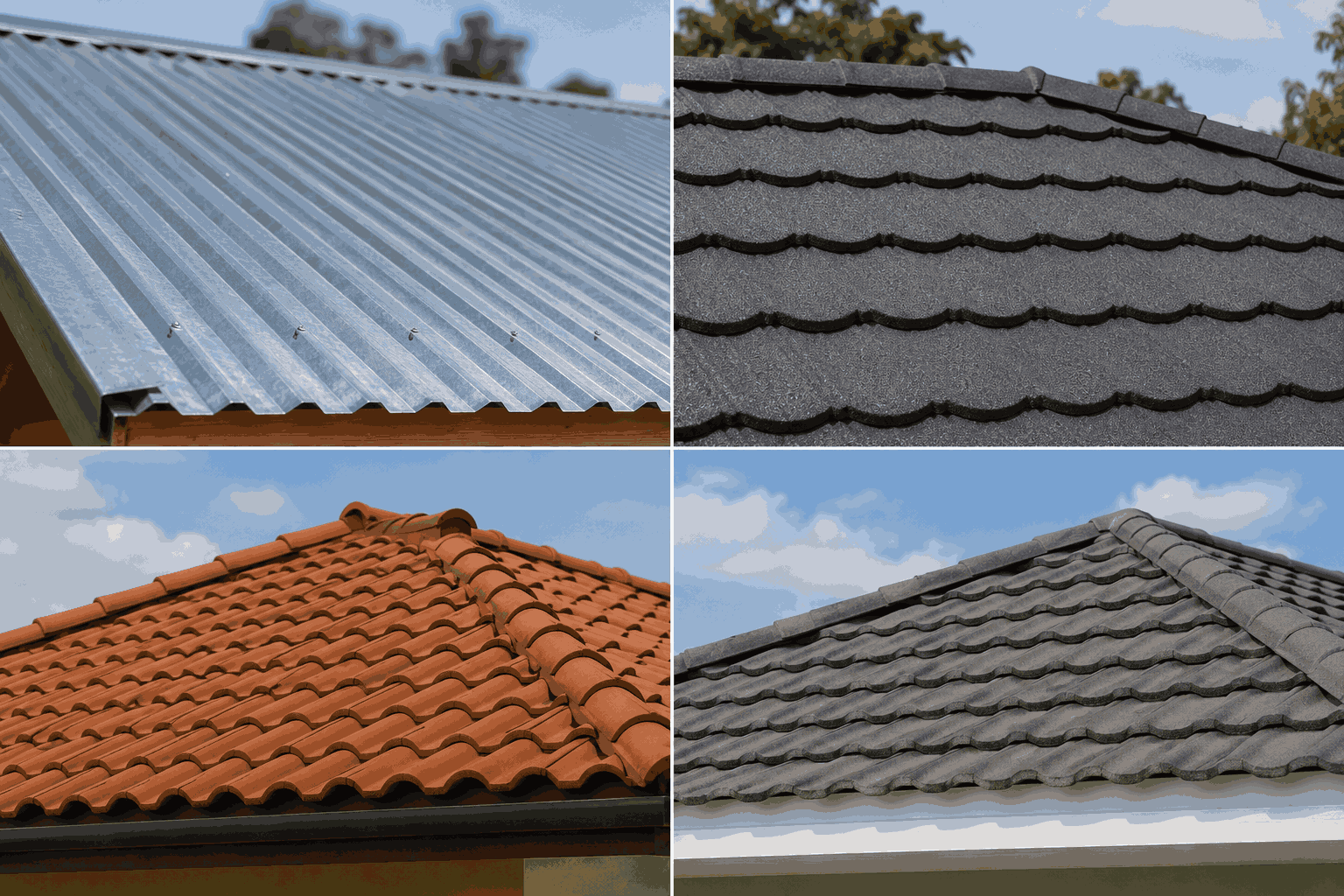
From left: corrugated mabati, box profile, stone-coated tile, and clay tile. The right choice depends on your budget, location, and how long you are building for.
Stone-Coated Roofing Tiles - The Best Long-Term Value
Stone-Coated Steel Roofing Tiles
Stone-coated roofing tiles are steel sheets coated with stone granules bonded with acrylic resin. They look like clay tiles from the street - textured, dimensional, attractive - but they are a fraction of the weight and significantly cheaper to install. Leading brands available in Kenya include Decra, Mareba, Classic, and several locally produced options.
The case for stone-coated tiles comes down to lifespan and total cost of ownership. A quality stone-coated roof lasts 40 to 50 years. Decra tiles carry a 50-year manufacturer warranty. Over that period, you will replace a corrugated G28 mabati roof at least three times. When you add up three replacements plus three installations, stone-coated tiles are often cheaper over the life of the building even though the upfront cost is higher.
Stone-coated tiles also insulate better than plain metal sheets. The stone granule layer and air gap beneath the tiles reduces both heat transmission and rain noise, two of the most common complaints about standard mabati roofs.
One important caveat: not all stone-coated tiles in the Kenyan market are equal. Poor quality sheets shed their stone granules within five years, exposing the steel beneath to rust. Always specify Gauge 26 (0.40mm) minimum and buy from reputable suppliers who can provide documentation on the product. If a quote looks suspiciously cheap for stone-coated tiles, the quality is the reason.
- 40 to 50 year lifespan - lowest lifetime cost
- Looks like clay tile at a fraction of the weight
- Quieter in rain than standard mabati
- Better heat insulation than plain metal
- Strong warranties from reputable brands
- Rust-resistant with aluzinc base
- Higher upfront cost than plain mabati
- Quality varies - poor products fail early
- Requires correct installation - improper nailing damages granules
- Minimum roof pitch of 12 to 15 degrees needed
Clay Roofing Tiles - The Premium Coastal and Heritage Choice
Clay Roofing Tiles
Clay tiles are made from natural clay fired at high temperatures until ceramic-hard. They are what you see on Mombasa's old coastal villas, the classic orange-red rooflines that define much of Kenya's most beautiful domestic architecture. They are heavy, they are expensive upfront, and they last 50 to 70 years - often outliving the timber structure beneath them.
For coastal Kenya - Mombasa, Malindi, Kilifi, Lamu - clay tiles are genuinely the best choice available. They are impervious to salt air. They do not rust, they do not corrode, and they do not require coating or repainting. The salt and humidity that destroys standard galvanized mabati in three to five years has no meaningful effect on a properly installed clay tile roof.
Clay tiles also provide excellent natural insulation. The terracotta mass absorbs heat during the day and releases it slowly, moderating interior temperatures without mechanical cooling. In a climate where air conditioning is expensive to run, this thermal mass has real value.
The limitations are structural and financial. Clay tiles are heavy - your roof structure must be designed and sized to carry them. A standard light timber truss built for mabati cannot support clay tiles without modification or replacement. This structural cost must be factored into the total budget, not just the tile cost. Popular brands in Kenya include Clayworks.
- 50 to 70 year lifespan - longest available
- Completely salt and corrosion resistant
- Excellent natural insulation and thermal mass
- Classic aesthetic - adds significant property value
- Virtually maintenance-free once installed
- Non-combustible - fire safe
- Heaviest roofing option - needs strong roof structure
- Highest upfront supply and installation cost
- Requires skilled installation - mistakes are expensive
- Individual tiles can crack under impact
- Longer lead times from suppliers
Concrete Roofing Tiles - Durable, Affordable, and Underrated
Concrete Roofing Tiles
Concrete tiles are made from cement, sand, and colour pigments, pressed into shape and cured. They are significantly cheaper than clay tiles while offering similar durability in most Kenyan climates - concrete tiles last 40 to 60 years with minimal maintenance. They come in a wide range of shapes, colours, and finishes, giving designers and homeowners real flexibility.
Concrete tiles are the practical choice when you want a tile roof without the clay tile price or the weight complexity. They are popular across Nairobi's middle and upper-market residential areas, performing well in the highlands climate with its heavy rains and temperature variation.
Like clay, concrete tiles are heavy and require a properly sized roof structure. They also absorb more moisture than clay over time, which can lead to colour fading and moss growth in high-humidity areas if not treated periodically. For coastal locations, clay tiles or stone-coated options remain preferable over concrete.
- 40 to 60 year lifespan
- 20 to 40% cheaper than clay tiles
- Wide range of designs and colours
- Excellent in highland and inland climates
- Good fire resistance
- Heavy - needs strong roof structure
- Absorbs moisture - can fade and grow moss
- Not ideal for coastal environments
- Heavier than stone-coated, adds structural cost
Versatile and Roman Tile Profile Mabati
Versatile Tile and Roman Tile (Orientile) Mabati
Versatile tile and Roman tile are pressed steel sheets shaped to resemble clay tiles. They offer the tile aesthetic at a lower cost than actual clay or concrete, and they are lighter, making them compatible with standard mabati roof trusses without structural modification. From street level on a well-designed home they are hard to distinguish from real tiles.
Versatile tile profiles are available from brands including Mabati Rolling Mills (Versatile), Royal Mabati (Roman Longtile), and Mabati Yetu. Prices range from KES 900 to 1,300 per metre. The Roman tile or Orientile version has a wavy Italian-inspired pattern and a glossy finish, slightly higher in price and commonly used in upscale residential and institutional buildings.
These profiles sit in the gap between plain mabati and stone-coated tiles, both in price and in performance. They do not have the stone granule layer that insulates and quiets stone-coated tiles, but they look significantly better than corrugated or box profile sheets on a high-specification home.
- Tile appearance at mabati weight
- No structural upgrade needed for most homes
- Wider design choice than plain mabati
- More affordable than actual tiles
- Not as durable as stone-coated tiles
- Does not insulate as well as stone-coated
- Still noisy in heavy rain
Roofing Shingles in Kenya
Asphalt and Bitumen Shingles
Roofing shingles are gaining popularity on high-end homes in Nairobi and other urban centres, particularly among homeowners going for a North American or European architectural aesthetic. They are thin, flat overlapping pieces of bituminous material, installed in overlapping rows to create a weather-tight surface.
Shingles are excellent for aesthetics and moderate in durability, lasting 15 to 30 years depending on quality. They are not the right choice for Kenya's coastal climate - humidity and salt air degrade bituminous materials faster than in temperate climates. They work well in Nairobi and higher-altitude areas with moderate humidity.
At roughly KES 2,500 per square foot installed, shingles are a premium choice without the durability advantage of stone-coated tiles or clay. For most Kenyan homeowners, stone-coated tiles deliver a similar premium aesthetic at better lifetime value. Shingles are for when a specific architectural look is the priority.
2026 Roofing Material Prices in Kenya
Prices below are current market figures for 2026, sourced from factory and supplier data. All are supply-only - installation adds 25 to 40% depending on roof complexity. Prices vary by region: Mombasa and upcountry buyers typically pay transport surcharges on top of these base rates.
| Material | Price per m² (Supply) | Gauge / Type | Lifespan |
|---|---|---|---|
| Corrugated Mabati G30 | KES 490 to 600/m² | 0.30mm - temporary use | 5 to 10 years |
| Corrugated Mabati G28 | KES 580 to 750/m² | 0.35mm - standard residential | 10 to 15 years |
| Corrugated Mabati G26 | KES 720 to 900/m² | 0.40mm - heavy duty | 15 to 25 years |
| Box Profile G28 | KES 580 to 800/m² | 0.35mm - standard | 10 to 20 years |
| Box Profile G26 | KES 720 to 1,000/m² | 0.40mm - recommended | 20 to 30 years |
| Versatile / Roman Tile Profile | KES 900 to 1,300/m² | G26 standard | 20 to 30 years |
| Stone-Coated Tiles (standard) | KES 2,800 to 3,500/m² | G26 / 0.40mm base | 40 to 50 years |
| Stone-Coated Tiles (Decra brand) | KES 3,200 to 4,200/m² | 50-year warranty | 50+ years |
| Concrete Roofing Tiles | KES 600 to 1,500/m² | Supply only, no labour | 40 to 60 years |
| Clay Roofing Tiles | KES 1,400 to 3,200/m² | Varies by size and finish | 50 to 70 years |
| Asphalt Shingles | KES 1,800 to 3,000/m² | Standard residential | 15 to 25 years |
Prices are indicative 2026 supply rates and exclude VAT, delivery, underlayment, accessories, and installation labour. For a full installation quote including trusses, underlayment, and labour, contact Universal Innovations and Industrial Ltd.
Which Roofing Material Works Best in Each Kenyan Climate
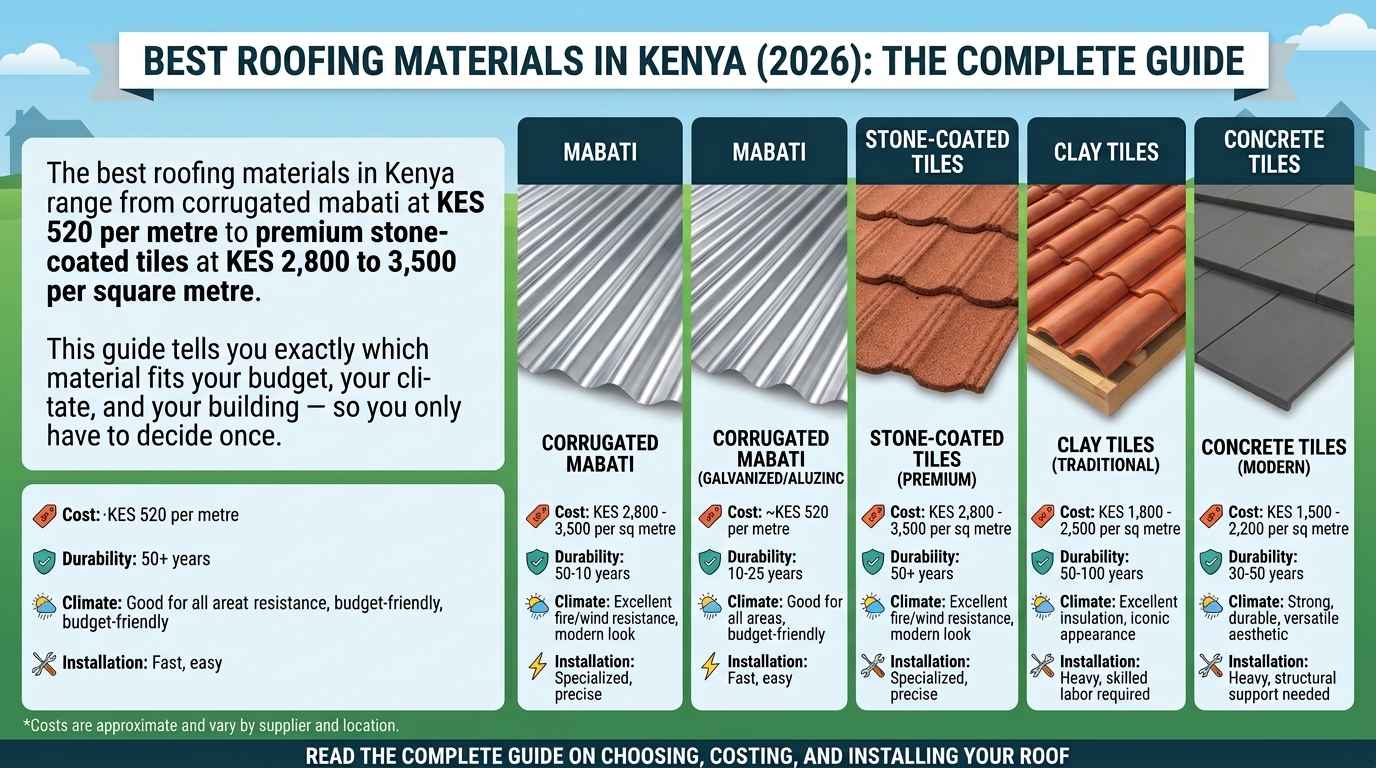
Kenya's climate zones vary dramatically from coast to highlands to arid north. The right roofing material depends as much on location as it does on budget.
Coastal Kenya (Mombasa, Malindi, Kilifi, Lamu)
Salt air destroys standard galvanized mabati within 3 to 5 years. Use clay tiles for maximum longevity (50 to 70 years), aluzinc-coated mabati (zinc-aluminium coating resists salt), or stone-coated tiles on an aluzinc base. Avoid standard galvanized sheets and plain concrete tiles in areas with direct sea exposure.
Nairobi and Central Highlands
Heavy rains, UV intensity, and temperature swings are the main challenges. Stone-coated tiles are the premium choice. Box Profile G26 pre-painted works well on a budget. Concrete tiles are a solid mid-range option for highlands rainfall. Avoid very light G30 gauge - hail can dent and puncture thin sheets.
Kisumu and Western Kenya
High rainfall and humidity mean moisture resistance is critical. Pre-painted box profile or stone-coated tiles perform well. Standard galvanized sheets rust faster in high humidity - go coated or go tile. Roof pitch matters here - ensure good drainage gradient to handle the heavy lake-region rains.
Arid and Semi-Arid Areas (Turkana, Garissa, Marsabit)
Extreme heat, low rainfall, and dust. Reflective pre-painted mabati (light colours like white or silver-grey) is often the practical choice - it reduces interior heat gain. Heavy materials like clay or concrete tiles can work but the truss cost in remote areas is significant. Match the roofing to the structure budget available.
Lifespan and Lifetime Cost - The Honest Comparison
The single biggest mistake Kenyan homeowners make is comparing roofing materials on upfront cost alone. When you factor in replacement cycles over 30 years, the calculation changes significantly.
| Material | Lifespan | Replacements in 50 years | Total cost over 50 years* | Verdict |
|---|---|---|---|---|
| Corrugated G28 | 10 to 15 yrs | 3 to 4 times | KES 3,500 to 4,500/m² | Cheapest now, most expensive long-term |
| Box Profile G26 | 20 to 30 yrs | 1 to 2 times | KES 2,000 to 3,000/m² | Good balance for medium-term builds |
| Stone-Coated Tiles | 40 to 50 yrs | 0 to 1 time | KES 2,800 to 3,500/m² | Best total value for permanent homes |
| Clay Tiles | 50 to 70 yrs | 0 times | KES 1,400 to 3,200/m² | Highest upfront, lowest long-term especially coastal |
| Concrete Tiles | 40 to 60 yrs | 0 to 1 time | KES 1,500 to 2,500/m² | Solid long-term value for inland locations |
*Total cost estimates include supply, installation, and estimated replacement cycles at current market rates. Does not include structural upgrades for tile roofs.
What this table shows clearly is that stone-coated tiles and clay tiles are actually cheaper per year of ownership than corrugated mabati on a building you plan to keep for 30 or more years. The roof you replace three times costs more in total than the one you install once.
How to Decide - A Simple Framework
Use these scenarios to match your situation to the right material:
Box Profile G26 pre-painted for tight budgets. Stone-coated tiles if you can stretch - the lifetime cost justifies the extra spend on a home you will own for 20 or more years.
Clay tiles if the structure can carry them and the budget allows. Aluzinc-coated stone-coated tiles as the second choice. Do not use standard galvanized mabati within 15km of the ocean.
Box Profile G26 or Versatile tile profile. Strong enough to last a tenant cycle, presentable enough to command a good rent, affordable enough to protect your yield.
Stone-coated tiles (Decra or equivalent) for a modern premium finish. Clay tiles for a heritage or coastal aesthetic. Either adds real property value and delivers 40 to 70 years without replacement.
Box Profile G26 is the standard specification. For large-span industrial structures, the profile gauge and purlin spacing need to be engineered to the specific span. Contact us for specification advice on larger commercial projects.
Corrugated G28 is appropriate and economical. No point in spending on premium materials for a structure that will be moved or demolished within ten years.
Roofing Installation in Kenya - What to Expect and What to Ask
At Universal Innovations and Industrial Ltd, we install roofing across Kenya as part of our wider construction and renovation services. Here is what the installation process involves and what you should ask any contractor before you hire them.
- Roof truss design and installation - trusses must be sized for the material you are using. A truss designed for mabati will not safely carry clay or concrete tiles without modification. Always confirm the structural specification before the truss is installed.
- Underlayment and sarking - a waterproof membrane under the roofing material protects against water ingress if a sheet or tile is damaged. It also reduces rain noise on metal roofs. We recommend underlayment on all permanent installations.
- Sheet or tile installation - starts from the eaves and works up. Correct overlap, correct fixing spacing, and correct ridge capping are critical. Poorly fixed roofing leaks at fixings and lifts in high wind.
- Ridge and verge capping - the ridge line must be properly capped and sealed. This is where most roof leaks start when installation quality is poor.
- Gutters and downpipes - properly sized gutters prevent water from saturating foundations and walls. Sized for the roof area and the rainfall intensity of your location.
For a complete roofing assessment, installation quote, or advice on the right specification for your project, visit our structural and roofing works page or contact us directly.
Ready to Roof Right the First Time?
Universal Innovations and Industrial Ltd installs roofing across Kenya - from standard mabati on residential builds to premium stone-coated and clay tile installations on high-specification projects. We will advise you on the right material for your location, your budget, and your building before we touch a single sheet.
Frequently Asked Questions About Roofing Materials in Kenya
Universal Innovations and Industrial Ltd is a construction and civil engineering company operating across Kenya and Uganda. Our services include roofing installation, structural works, civil engineering and renovation, forecourt construction, and industrial fabrication. Visit universalinnovations.co.ke for more guides and to get in touch with our team.