

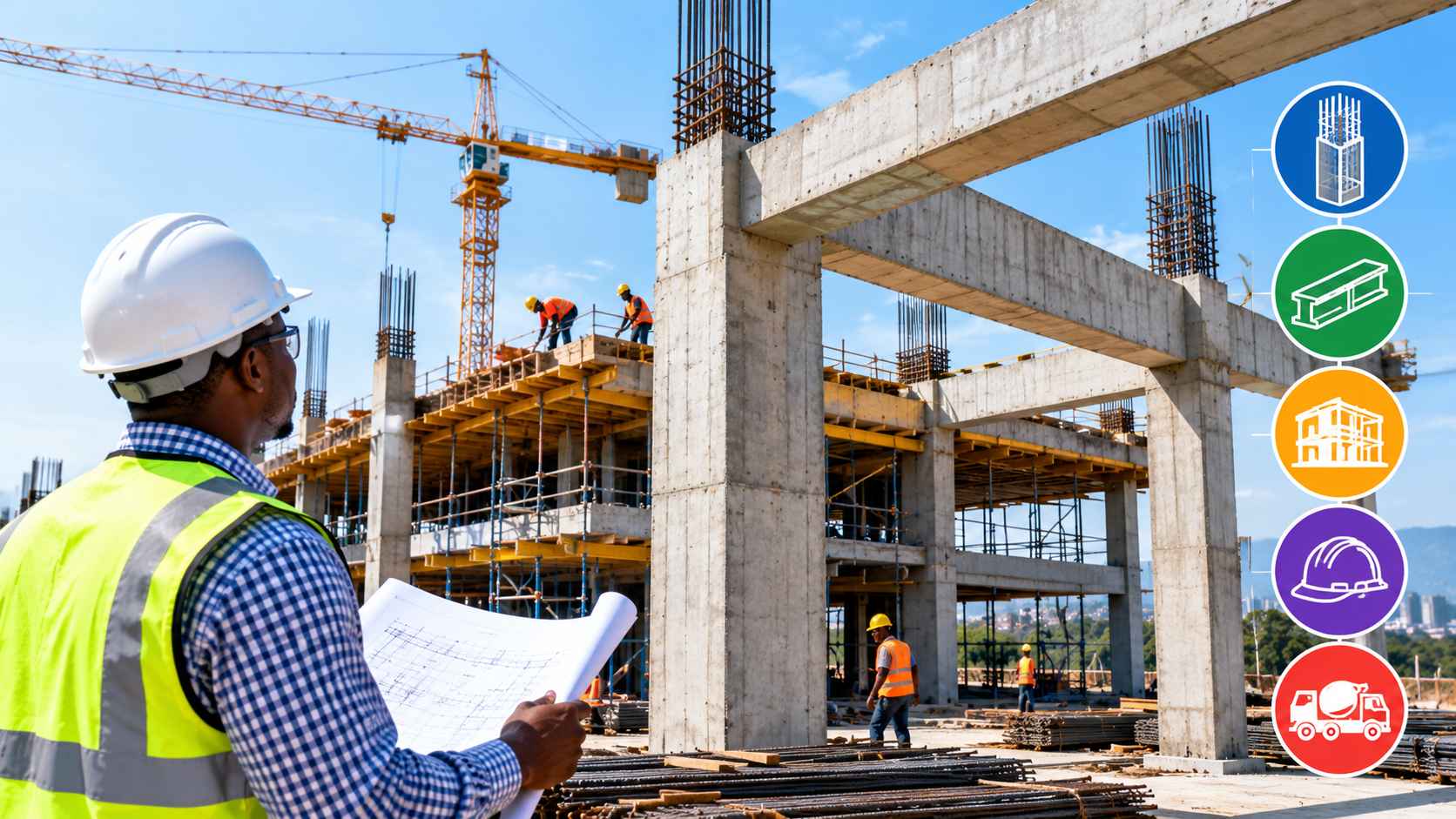
Accurately budgeting the cost of concrete structures - columns, beams, and slabs - in Kenya is one of the most consequential tasks in any large-scale construction project. Underestimate the structural frame and you face a funding gap at the worst possible point in the programme. Overestimate and you may lose the bid or reject a viable project. This guide provides a detailed, 2026-current breakdown of reinforced concrete pricing in Kenya, covering material costs, labour rates, ready-mix concrete prices, formwork, and worked elemental budgets - so developers, project managers, engineers, and quantity surveyors can build cost plans grounded in real market data.
What Drives Structural Concrete Costs in Kenya
Reinforced concrete structures are the dominant structural system for commercial, industrial, and multi-storey residential construction across Kenya. Before examining individual element costs, it is essential to understand the five variables that determine where any specific project sits within the cost ranges below.
1. Concrete Grade and Mix Design
The higher the structural grade specified, the more cement content required and the higher the material cost. Grade C20 is the minimum for most structural elements in Kenya. C25 is the standard for columns and beams in commercial buildings. C30 and above are specified for post-tensioned slabs, heavily loaded foundations, and coastal structures where durability requirements demand a lower water-cement ratio. Each step up in grade adds approximately 10-18% to the concrete material cost.
2. Ready-Mix vs. Site-Mixed Concrete
Ready-mix concrete - batched at a controlled plant and delivered by transit mixer - commands a premium over site-mixed concrete but delivers significantly better consistency, quality, and compliance with structural specifications. For large pours on any project above three storeys, or any project where structural engineer oversight requires cube test compliance, ready-mix is the correct specification. Site-mixing is cost-effective for smaller rural projects or non-structural concrete but should not be used for primary structural elements on regulated projects.
3. Reinforcement Quantity and Detailing
Steel reinforcement typically represents 40-60% of the total structural element cost for heavily reinforced elements such as transfer beams and heavily loaded columns. The amount of reinforcement is set by the structural engineer's design and cannot be reduced without a formal design change. Contractors who cut steel quantities to save cost without engineer approval are creating structural deficiency - not savings.
4. Formwork System
Formwork - the temporary mould that holds wet concrete in shape while it cures - is a major cost driver that varies significantly between projects. Timber formwork is the most common system in Kenya and is relatively low cost per use, but has limited reuse cycles. Proprietary steel or aluminium formwork systems have a higher initial cost but are economical on large repetitive projects with many identical floors. Post-tensioned flat slab systems reduce formwork complexity but require specialist contractors and equipment.
5. Location and Site Logistics
Construction costs outside Nairobi vary based on material transport distances, availability of skilled labour, and the cost of mobilising equipment. Projects in Nairobi, Mombasa, and Kisumu benefit from the best material availability and labour supply. Projects in secondary towns (Nakuru, Eldoret, Thika) typically add 5-12% to Nairobi baseline rates. Remote or difficult-access sites can add 15-25% or more to structural costs, primarily from transport, plant mobilisation, and the premium on attracting experienced foremen and steel fixers to remote locations.
Material Prices: Concrete, Reinforcement Steel & Formwork in Kenya (2026)
Ready-Mix Concrete Prices Kenya 2026
Ready-mix concrete in Kenya is produced by batching plants primarily in Nairobi, Mombasa, Kisumu, and Nakuru and delivered by transit mixer trucks. Prices vary by grade, delivery distance, pour volume, and whether pumping is required.
| Concrete Grade | Typical Use | Price Range (KES/m³) | Notes |
|---|---|---|---|
| C15 / Class 15 | Blinding, kerbs, non-structural fill | 9,000 – 10,500 | Low cement content. Not for structural elements. |
| C20 / Class 20 | Ground floor slabs, lightly loaded columns | 10,500 – 12,000 | Minimum grade for most structural elements per BS 8500. |
| C25 / Class 25 | Columns, beams, suspended slabs - standard commercial | 12,000 – 13,500 | Most commonly specified for commercial RC frames in Kenya. |
| C30 / Class 30 | Post-tensioned slabs, transfer structures, coastal works | 13,500 – 15,500 | Higher cement content. Required in aggressive exposure conditions. |
| C35 / Class 35 | High-rise columns, heavily loaded foundations | 15,000 – 17,500 | Specialist mix. Confirm pump pressure rating with supplier. |
Pumping surcharges for upper floors add approximately KES 800 - 1,500/m³ depending on pump height and site access. Small-load surcharges apply for orders below the minimum order quantity (typically 3-6m³). Always confirm whether the quoted price includes delivery, pump hire, and offloading.
Reinforcement Steel Bar Prices Kenya 2026
Reinforcement steel (rebar) in Kenya is denominated by bar diameter. Prices below are per 12-metre bar in Nairobi as at early 2026. Prices in upcountry locations are typically 5-15% higher due to transport costs.
| Bar Size | Primary Structural Use | Price per 12m Bar (KES) | Approx. KES per Tonne |
|---|---|---|---|
| D8 | Stirrups, links, light slab reinforcement | 605 | ~130,000 |
| D10 | Slab mesh, secondary reinforcement | 920 | ~120,000 |
| D12 | Column and beam reinforcement | 1,335 | ~115,000 |
| D16 | Main column bars, primary beam tension reinforcement | 2,325 | ~112,000 |
| D20 | Heavily loaded columns, transfer beams, raft foundations | 3,850 | ~110,000 |
| D25 | Large column sections, bridge structures, pile caps | 6,875 | ~108,000 |
All reinforcement steel used on NCA-registered projects in Kenya must comply with KEBS standards KS 573 (cold-worked high yield steel bars) or KS ISO 6935-2 (ribbed bars). Substandard steel - a documented problem in the Kenyan market - is one of the primary causes of structural failures. Always obtain KEBS compliance documentation from your steel supplier and conduct mill test certificates for large orders.
Formwork Costs Kenya 2026
| Formwork Type | Application | Cost Range (KES/m²) | Notes |
|---|---|---|---|
| Timber (softwood plywood) | Slabs, beams, columns - standard use | 1,200 – 2,200 | Supply, erect, and strike. 3-5 reuses typical. Most common in Kenya. |
| Proprietary steel / aluminium | Repetitive slabs and columns on multi-storey projects | 2,500 – 4,500 | Higher unit cost but 50+ reuses makes it cost-effective on large projects. |
| Column forms (cylindrical) | Circular or complex column shapes | 2,000 – 3,500 | Cardboard tube forms for circular columns widely available in Nairobi. |
| Precast slab system (T-beam & block) | Suspended floors - no formwork required | 3,000 – 5,000/m² | Supply and install cost. Eliminates formwork cost but requires structural review. |
Concrete Column Costs in Kenya (2026)
Columns are the vertical load-bearing elements of a reinforced concrete frame, transferring loads from beams and slabs down through the structure to the foundations. Their cost is driven primarily by the column cross-section, the concrete grade, the reinforcement ratio (typically 1-4% of gross section area for columns in commercial buildings), and the storey height.
200mm x 200mm to 300mm x 300mm. C25 concrete, 4 x D12 main bars, D8 links at 150mm centres. Typical for residential buildings up to 4 storeys.
300mm x 300mm to 450mm x 450mm. C25-C30 concrete, 8 x D16 main bars, D8 links. Standard for 5-10 storey commercial office buildings in Nairobi.
500mm x 500mm and above. C30-C35 concrete, 12+ D20 or D25 main bars. Basement columns, transfer levels, and high-rise structures carrying very high loads.
What Makes Column Costs Vary
- Storey height - A 4m floor-to-floor column costs more than a 3m column of the same section because it requires more material, more formwork, and more labour to pour and vibrate correctly
- Reinforcement congestion - Heavily reinforced columns (above 3% steel ratio) are significantly more expensive to fix and pour than lightly reinforced ones - the steel takes longer to fabricate, fix, and vibrate concrete through
- Number of columns - Large quantities of identical columns allow formwork to be reused many times, reducing per-column cost significantly compared to a small number of varied column sizes
- Access and height - Columns at upper levels require scaffolding, crane time, or pump access, all of which add cost compared to ground-level work
Concrete Beam Costs in Kenya (2026)
Beams span horizontally between columns, carrying slab loads and transferring them to the columns. They are among the most reinforcement-intensive elements in a typical RC frame, with the tension reinforcement, compression reinforcement, shear stirrups, and top bars all requiring careful fabrication and fixing before concrete can be poured.
| Beam Type | Typical Size | Cost Range (KES/linear metre) | Notes |
|---|---|---|---|
| Secondary / lintel beam | 200mm x 300mm – 230mm x 400mm | 12,000 – 22,000 | Carries slab loads to primary beams or walls. Light reinforcement. |
| Primary beam (standard) | 300mm x 450mm – 350mm x 600mm | 28,000 – 55,000 | Spans between columns. C25. Typical for 5-8m spans in office buildings. |
| Primary beam (long span) | 400mm x 700mm – 450mm x 900mm | 60,000 – 110,000 | Spans of 8-12m. Higher reinforcement content. C25-C30. |
| Transfer beam | 600mm x 1,000mm – 800mm x 1,500mm+ | 150,000 – 400,000+ | Carries column loads above openings or car parks. Heavily reinforced. C30-C35. Requires specialist engineering and quality control. |
| Ring beam / tie beam | 150mm x 225mm – 225mm x 350mm | 8,500 – 16,000 | Foundation or wall tie beams. Standard in Kenya's bearing wall construction. |
Concrete Slab Costs in Kenya (2026)
Slabs form the floors and roofs of reinforced concrete buildings. They are the highest volume concrete element in most multi-storey structures and therefore have a significant influence on the overall structural frame budget. Kenya's market offers three main slab system options for large-scale structures, each with different cost profiles:
In-Situ Reinforced Concrete Slab
Poured in place on timber or steel formwork. The most common system for commercial and industrial buildings in Kenya. Cost varies significantly with slab thickness, concrete grade, and reinforcement arrangement.
| Slab Type | Thickness | Concrete Grade | Cost Range (KES/m²) |
|---|---|---|---|
| Ground floor slab (lightly reinforced) | 100-150mm | C20 | 2,800 – 4,500 |
| Suspended slab - residential (standard) | 150mm | C25 | 5,500 – 8,500 |
| Suspended slab - commercial (standard) | 175-200mm | C25 | 7,500 – 12,000 |
| Flat slab (without beams) | 200-250mm | C25-C30 | 10,000 – 16,000 |
| Post-tensioned flat slab | 220-280mm | C30-C35 | 14,000 – 22,000 |
| Industrial floor slab (heavy duty) | 200-300mm | C30-C35 | 8,500 – 18,000 |
Precast T-Beam and Block Slab System
Precast concrete T-beams spanning between supports with hollow blocks filling the bays, topped with a 50-75mm structural screed. This system eliminates most formwork and shoring, which reduces programme time and formwork cost significantly. In Kenya in 2026, precast slab systems cost KES 3,000 - 5,000/m² supply and install depending on span. The structural engineer must confirm that the precast system meets the required loading and that the topping slab design is appropriate.
Post-Tensioned Flat Slab
Post-tensioned slabs are increasingly used in Nairobi's commercial office and car park structures because they allow longer column-free spans, reduce slab depth (and therefore overall building height per floor), and can reduce the total concrete and reinforcement content compared to a conventional flat slab of equivalent span. The premium in material and specialist contractor cost is typically recovered through programme savings and reduced structural frame weight. Suitable for projects with spans above 8m or where architectural requirements demand column-free floor plates.
Worked Budget: 5-Storey Reinforced Concrete Frame in Nairobi (2026)
The following worked example illustrates how structural element costs combine into a frame budget for a typical 5-storey commercial office building in Nairobi - approximately 1,000m² GFA per floor, 5,000m² total, on a 20m x 50m plan with a regular 5m x 8m column grid.
| Element | Quantity | Rate (KES) | Indicative Cost (KES) |
|---|---|---|---|
| RC Columns 300x300mm, C25, 5 floors x 40 columns, avg 3.5m/storey |
700 lin. m | 48,000/lm | 33,600,000 |
| Primary Beams 350x600mm, C25, 8m spans, 5 floors |
1,800 lin. m | 45,000/lm | 81,000,000 |
| Secondary Beams 230x400mm, C25, 5m spans, 5 floors |
2,200 lin. m | 18,000/lm | 39,600,000 |
| Suspended RC Slabs 175mm, C25, 5 floors x 1,000m² (net of beams) |
4,800 m² | 9,500/m² | 45,600,000 |
| Roof Slab 150mm, C25 |
950 m² | 8,000/m² | 7,600,000 |
| RC Staircase Structures (2 cores) | Lump sum | - | 8,500,000 |
| Lift Core Walls (RC shear walls) | Lump sum | - | 12,000,000 |
| Concrete Pump Hire Allowance | Lump sum | - | 4,200,000 |
| Cube Testing and QA | Lump sum | - | 1,800,000 |
| Structural Frame Subtotal | KES 46,820/m² GFA | 233,900,000 | |
| Contingency on structural (8%) | 18,712,000 | ||
| Total RC Frame Budget | approx. KES 50,500/m² GFA | ~252,600,000 |
Controlling Your Structural Concrete Budget
Structural concrete cost overruns on Kenyan projects are common and usually preventable. The following disciplines are the difference between a project that delivers its structural frame on budget and one that does not.
Commission a Structural Engineer Before Budgeting
Cost plans built on assumed column sizes and slab thicknesses are unreliable. The structural engineer's preliminary design - even at concept stage - will tell you the actual column grid, element sizes, and concrete grades. This takes the guesswork out of the structural budget and allows your quantity surveyor to produce a meaningful estimate rather than a guess.
Use a Priced Bill of Quantities for Tendering
Tendering the structural frame as a lump sum without a Bill of Quantities makes variation pricing opaque and disputes almost inevitable. A priced BoQ gives you a transparent rate schedule against which every variation can be valued, and tells you exactly what each element costs before you commit to a contractor.
Specify Ready-Mix for All Structural Elements
The cost saving from site-mixing structural concrete is rarely more than KES 1,500 - 2,500/m³ compared to ready-mix. The quality risk - inconsistent water-cement ratio, incorrect mix proportions, inadequate strength - is not worth that saving on any structural element. Specify ready-mix and cube-test every pour.
Implement Formal Materials Management
Reinforcement steel is one of the most commonly misappropriated materials on Kenyan construction sites. A formal materials management system - goods received notes, stock records, material reconciliation against pour volumes - is essential on any project above three storeys. Our Structural Works team implements materials tracking as a standard site management practice on all projects.
Build a Real Contingency Into Your Budget
Structural works contingencies should be a minimum of 8% for straightforward projects and 12-15% for projects with complex foundations, difficult ground conditions, or unusual structural forms. A contingency that is absorbed into the base budget before construction begins is not a contingency - it is an underfunded cost plan.
Frequently Asked Questions
How much does a reinforced concrete column cost in Kenya in 2026?+
In Kenya in 2026, reinforced concrete column costs range from approximately KES 18,000 - 32,000 per linear metre for a small 200-300mm square column in a residential building, up to KES 70,000 - 150,000+ per linear metre for a large heavily reinforced column in a commercial high-rise or basement structure. The mid-range for a standard 300-450mm commercial column is KES 35,000 - 65,000 per linear metre. These rates include concrete supply and pour (C25), reinforcement fixing, formwork erection and striking, and basic curing - but exclude pump hire, scaffolding, and preliminaries.
What is the cost of a concrete slab per square metre in Kenya in 2026?+
Concrete slab costs in Kenya in 2026 vary significantly by slab type and specification. A lightly reinforced ground floor slab (100-150mm, C20) costs approximately KES 2,800 - 4,500/m². A standard suspended RC slab for a residential building (150mm, C25) costs KES 5,500 - 8,500/m². A commercial suspended slab (175-200mm, C25) costs KES 7,500 - 12,000/m². Post-tensioned flat slabs for long-span commercial structures cost KES 14,000 - 22,000/m². Precast T-beam and block slab systems range from KES 3,000 - 5,000/m² supply and install and eliminate most formwork cost.
What is the price of ready-mix concrete per cubic metre in Kenya in 2026?+
Ready-mix concrete prices in Kenya in 2026 range from approximately KES 9,000/m³ for C15 blinding concrete up to KES 17,500/m³ for C35 high-strength structural concrete. The most commonly specified grade for structural columns, beams, and suspended slabs - C25 - typically costs KES 12,000 - 13,500/m³ delivered. Add KES 800 - 1,500/m³ for concrete pump hire where required for upper-floor pours. Prices vary between suppliers and are higher outside Nairobi due to transport costs. Always confirm whether the quoted price includes delivery, pump, and offloading or if these are charged separately.
How much does structural concrete work cost per square metre of GFA in Kenya?+
For a typical 5-10 storey commercial office building in Nairobi in 2026, the structural RC frame - columns, beams, slabs, staircase cores, and shear walls - costs approximately KES 40,000 - 60,000 per m² of gross floor area before contingency. This represents 30-45% of the total construction cost for a mid-market office building. The structural frame budget varies significantly with the column grid spacing (longer spans require larger beams), number of floors (more floors means more column reinforcement at lower levels), and specification of special elements such as transfer beams or post-tensioned slabs.
Should I use site-mixed or ready-mix concrete for structural elements in Kenya?+
For all primary structural elements - columns, beams, and suspended slabs - on projects above two storeys in Kenya, ready-mix concrete is the correct specification. Ready-mix is produced under controlled batching plant conditions, achieving consistent water-cement ratios, correct aggregate gradation, and reliable grade compliance that site-mixing cannot match. The cost difference between site-mixed and ready-mix concrete for structural elements is typically KES 1,500 - 2,500/m³ - a small fraction of the total structural cost and far less than the liability created by weak or inconsistent site-mixed concrete. NCA-regulated projects and structural engineers' specifications increasingly mandate ready-mix for all structural pours.
What concrete grade should be used for columns and beams in Kenya?+
The concrete grade for structural elements is determined by the structural engineer's design, but the following are the typical specifications used in Kenya's commercial construction market in 2026. C25 is the standard grade for columns, beams, and suspended slabs in commercial buildings up to approximately 10 storeys. C30 is specified for post-tensioned slabs, transfer structures, heavily loaded lower-level columns in tall buildings, and any structural elements in coastal or aggressive exposure environments. C35 and above is used for high-rise columns, heavily loaded pile caps, and special structural elements. Using a lower grade than specified to save cost is a structural deficiency - not a value engineering decision - and creates long-term liability for the developer and contractor.
Budgeting a Large-Scale Concrete Structure in Kenya?
Our Structural Works team provides pre-construction cost advice, structural concrete specifications, and full delivery of RC frame structures for commercial, industrial, and civil projects across Kenya.
Talk to Our Structural Works Team