

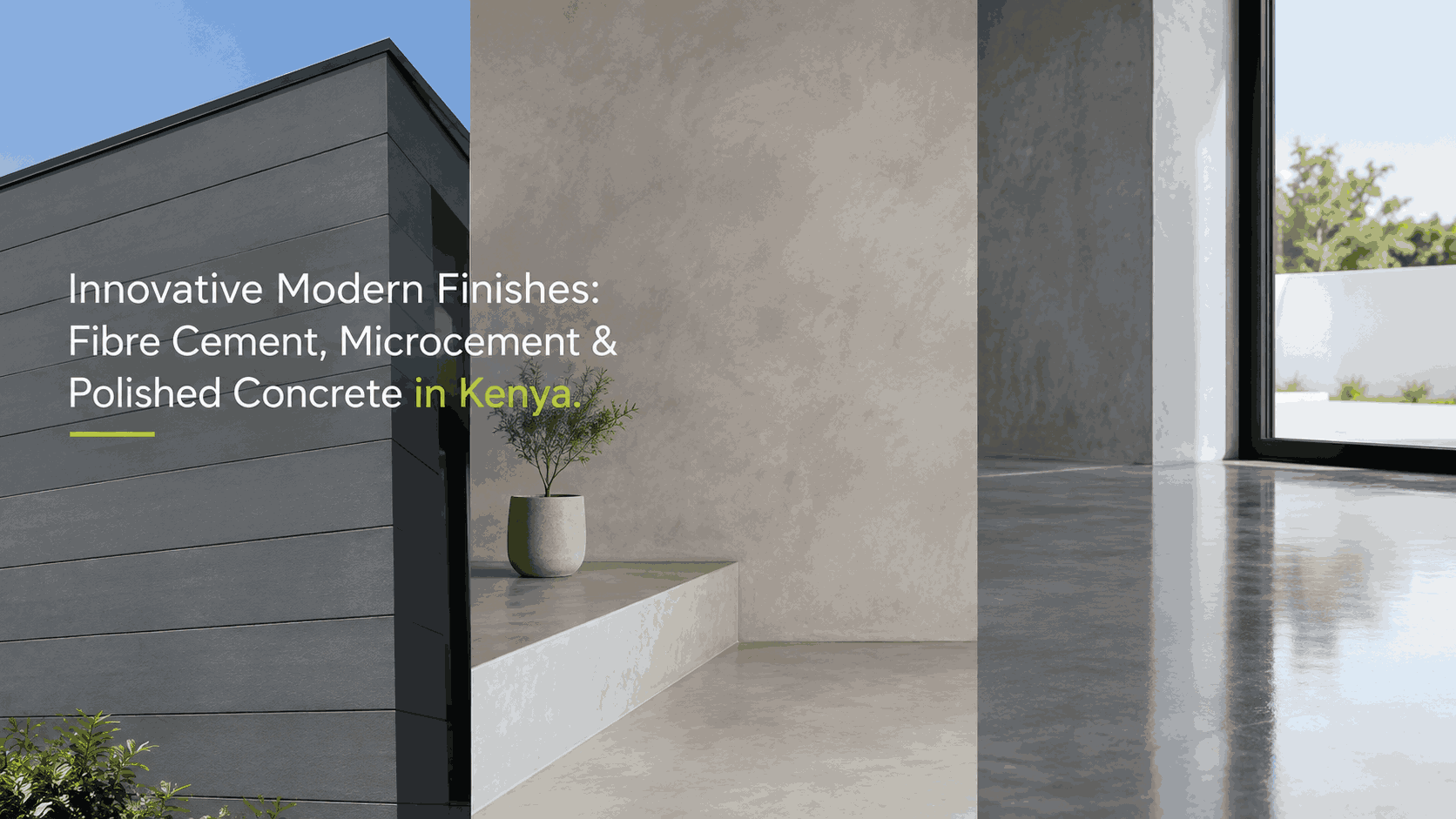
Kenya's built environment is changing. Across Nairobi's office parks, coastal hotels, residential developments in Karen and Kileleshwa, and commercial fit-outs from Kisumu to Mombasa, a new generation of surface finishes is replacing painted plaster and standard tiles. Microcement, polished concrete, and fibre cement board are now real, accessible options for Kenyan developers, architects, and property owners - each offering a specific combination of aesthetics, durability, and value that conventional finishes simply cannot match. This guide explains what each material is, where it works best, what it costs in Kenya, and how to choose between them.
Why Modern Finishes Are Growing in Kenya's Construction Market
Kenya's property market has matured. Tenants, buyers, and hotel guests have been exposed to international design standards through travel, social media, and the growing presence of multinational brands in Nairobi. The result is a measurable shift in specification expectations - particularly in commercial, hospitality, and high-end residential projects.
At the same time, the traditional Kenyan finish palette has real limitations. Ceramic tiles accumulate grime in grout lines, painted plaster requires frequent repainting, and standard floor screeds crack, dust, and stain within a few years of heavy use. Each of these failures costs money to fix - and creates operational disruption in commercial environments.
Modern finishes like microcement, polished concrete, and fibre cement board have grown in Kenya because they address these problems directly. They offer:
- Seamless surfaces with no grout lines to harbour bacteria or stain
- Superior durability - measured in decades, not years
- Lower long-term maintenance costs compared to tiles or painted finishes
- A contemporary aesthetic that appeals to premium tenants, clients, and guests
- The ability to be applied over existing surfaces in renovation projects, avoiding costly demolition
The Kenyan market has moved. Microcement suppliers now operate in Nairobi, polished concrete contractors are active across the city, and fibre cement board is available through specialist building materials importers. The question is no longer whether these finishes are accessible in Kenya - it is which one is right for your project.
Microcement in Kenya: The Seamless Finish Taking Over Interior Design
Microcement (also referred to as micro-cement, microtopping, or micro-concrete) is a thin decorative coating composed of cement, water-based resins, fine aggregates, and mineral pigments. Applied in layers of just 2-3mm directly over an existing substrate - tiles, concrete, plaster, or even wood - it creates a completely seamless, joint-free surface that can cover floors, walls, ceilings, bathroom wet areas, kitchen worktops, and even furniture.
It is one of the fastest-growing modern wall and floor finishes in Kenya, now used in hotels, lodges, high-end homes, restaurants, offices, and showrooms across Nairobi, Mombasa, Diani, Nanyuki, and the coast.
What Makes Microcement Different from Other Finishes?
The key distinction is the combination of seamlessness and flexibility. Unlike tiles, there are no grout lines. Unlike polished concrete, it does not require a structural pour - it is an overlay that goes on top of whatever substrate already exists. Unlike paint, it creates a tactile, mineral surface with real depth and texture.
Best Applications for Microcement in Kenya
- Hotel and lodge interiors - Bathrooms, feature walls, poolside areas, and lobby floors where a seamless, water-resistant finish is required without the weight or complexity of large-format stone
- Residential bathrooms and kitchens - Microcement creates fully waterproof wet areas without grout lines, eliminating the main maintenance complaint of tiled bathrooms
- Commercial offices and restaurants - Open-plan floors in a single continuous pour with no joins, no lippage, and a customisable colour palette
- Renovation projects - Applied directly over existing tiles or screed, microcement transforms a space without the disruption and cost of full demolition
- Feature walls and facade elements - Microcement can be applied externally in sheltered conditions, creating a modern raw-concrete look on boundary walls, entrance features, and landscaping elements
Durability and Maintenance
Properly applied and sealed microcement is scratch-resistant, stain-resistant, and durable under normal commercial and residential use. The surface is sealed with a polyurethane or epoxy sealer after application, which provides chemical resistance and waterproofing. In wet areas such as bathrooms and kitchens, a penetrating sealer is applied to prevent moisture ingress.
Maintenance is straightforward - regular sweeping and damp mopping. Avoid abrasive cleaners. Resealing every 3-5 years in heavily used floors maintains the finish. This is significantly less maintenance-intensive than grout cleaning in tiled surfaces.
Polished Concrete in Kenya: Raw, Durable, and Built to Last
Polished concrete involves grinding, honing, and polishing an existing or newly poured concrete slab using a sequence of diamond-tipped tooling, then treating with a chemical densifier and sealer to achieve a reflective, hardwearing surface. It is one of the most durable floor finishes available and one of the most cost-effective for large commercial, industrial, and warehouse spaces.
In Kenya's growing commercial construction sector - particularly in Nairobi's office parks, retail centres, showrooms, and industrial facilities - polished concrete is becoming the floor specification of choice where large areas, low maintenance, and long lifespan are the priority.
Why Polished Concrete Works in Kenya's Climate
Kenya's climate presents specific challenges for floor finishes - thermal cycling, occasional humidity, and dusty dry-season conditions. Polished concrete handles all of these well. Unlike vinyl or timber, it does not expand and contract with temperature changes. Unlike tiles, it has no grout lines to accumulate red laterite dust. Unlike painted floors, it does not peel or chip under foot traffic or wheeled equipment.
The reflective surface also reduces artificial lighting requirements - a polished concrete floor in a commercial space can meaningfully reduce electricity consumption from overhead lighting, which is a real operating cost saving in Kenya's commercial environment.
Best Applications for Polished Concrete in Kenya
- Warehouses and logistics centres - Handles forklift traffic, pallet jacks, and heavy loads. Virtually indestructible under normal industrial use.
- Retail and showrooms - Reflective surface enhances product display lighting. Low maintenance in high-foot-traffic environments.
- Office open-plan floors - Popular in contemporary open-plan office fit-outs seeking an industrial or minimalist aesthetic.
- Restaurant and hospitality floors - Easy to clean, no grout to stain, and develops a natural patina that ages well in character-driven hospitality spaces.
- Car showrooms and service centres - Chemical and stain resistance with an upmarket appearance.
Important Limitations
Polished concrete requires a quality concrete slab as its starting point. Cracks, pour joints, and aggregate variation in the base slab become visible features of the finished floor - which can be desirable aesthetically but must be considered in specification. It cannot be applied as an overlay to an existing tiled floor (unlike microcement). It is also cold underfoot, acoustically hard, and unforgiving if heavy objects are dropped on it. For spaces requiring warmth or acoustic comfort, a different finish may be more appropriate.
Fibre Cement Board in Kenya: The Modern Solution for Facades, Cladding, and Wet Areas
Fibre cement board (also called fibre cement cladding or FCB) is a composite panel manufactured from Portland cement, cellulose fibres, silica, and other additives, compressed and cured to form a rigid, dimensionally stable board. It is used for external wall cladding and facades, internal wet-area linings, ceiling soffits, partition systems, and as a tile-backer substrate in bathrooms and kitchens.
In Kenya, fibre cement board is increasingly specified for commercial and institutional buildings as an alternative to painted plaster on external facades and as a tile-backer in humid or wet-area applications where moisture-resistance is critical.
Why Fibre Cement Outperforms Plaster on Kenyan Exteriors
Painted render on Kenyan external walls has well-documented problems: cracking from thermal movement, algae and mould growth in humid coastal conditions, efflorescence from rising moisture, and the need for repainting every 3-5 years. Fibre cement board addresses every one of these failure modes:
- Dimensionally stable - does not crack from thermal cycling or moisture movement
- Resistant to mould, rot, and termites - critical in coastal and humid highland environments
- Factory-primed or pre-finished - reduces on-site painting labour and achieves a consistent finish quality
- Fire-resistant - complies with KEBS fire rating requirements for commercial buildings
- Lightweight - reduces structural load on facades compared to masonry or thick render
- Long design life - 25-50 years with appropriate maintenance, far exceeding painted render
Common Uses of Fibre Cement Board in Kenya
- External wall cladding and facades - Horizontal lap boards, vertical battens, or flat panel systems on commercial, institutional, and residential buildings
- Wet-area linings - Behind tiles in bathrooms, showers, and kitchens where moisture resistance is essential and standard gypsum board would be damaged
- Ceiling soffits and eaves - Resistant to moisture and insects in exposed soffit conditions
- Partition systems - As an alternative to gypsum board in areas with potential water exposure, chemical splash, or impact risk
- Feature panels and architectural elements - Smooth fibre cement panels painted or left in natural grey as feature elements on contemporary facades
Microcement vs. Polished Concrete vs. Fibre Cement: Side-by-Side Comparison
| Criteria | Microcement | Polished Concrete | Fibre Cement Board |
|---|---|---|---|
| What it is | 2-3mm decorative coating applied over existing surfaces | Structural concrete slab ground and polished in place | Pre-formed composite panel fixed to structure |
| Primary use | Floors, walls, wet areas, worktops - interior and sheltered exterior | Floors - commercial, industrial, retail, warehouse | External cladding, wet-area linings, soffits, partitions |
| Applied over existing surface? | Yes - tiles, concrete, plaster, wood | No - requires a structural concrete slab | Fixed to framing or substrate - not an overlay |
| Thickness | 2-3mm | No added thickness (in-situ polish) | 6-18mm panel |
| Seamless finish? | Yes - fully seamless, no joints | Yes for the slab (expansion joints required for large areas) | No - panel joints require filling and treatment |
| Colour/design options | Very high - mineral pigments, matte to gloss sealers | Limited by aggregate and slab quality - grey tones | Wide - factory finished, painted, or natural grey |
| Water/moisture resistance | Excellent when sealed - suitable for full wet areas | Good when sealed - not ideal for prolonged ponding | Excellent - specifically designed for wet and external exposure |
| Durability / expected lifespan | 10-20 years with periodic resealing | 25-50+ years | 25-50 years on facades |
| Maintenance | Low - damp mop, reseal every 3-5 years | Very low - sweep, damp mop, reseal occasionally | Very low - clean and repaint periodically |
| Ideal for Kenya's climate | Yes - no thermal cracking, moisture resistant when sealed | Yes - excellent thermal stability | Yes - designed for tropical and variable climates |
| Suitable for renovation (no demolition)? | Yes - key advantage | Only if concrete slab already exists | Partial - can clad over existing facades |
Cost Guide: What to Budget for Modern Finishes in Kenya (2025)
All costs below are supply-and-apply estimates based on current Nairobi market rates. Costs vary depending on substrate condition, area size, finish level, and contractor. Larger areas typically achieve lower per-m² rates. Always obtain at least two itemised quotes from experienced specialist contractors.
| Finish Type | Application | Estimated Cost (KES/m²) | Key Cost Variables |
|---|---|---|---|
| Microcement | Floor (over concrete substrate) | 3,500 – 6,500 | Substrate preparation, area size, colour complexity, sealer grade |
| Wall (interior) | 4,500 – 8,000 | ||
| Wet area (bathroom / kitchen) | 6,000 – 12,000 | ||
| Polished Concrete | Basic honed finish (existing slab) | 800 – 1,800 | Existing slab quality, desired gloss level, densifier and sealer specification |
| High-gloss polished with sealer | 2,500 – 5,500 | ||
| Fibre Cement Board | External wall cladding (supply and fix) | 2,800 – 5,500 | Panel grade, framing system, height/access, painting or pre-finish spec |
| Wet-area lining (tile backer) | 1,200 – 2,500 | ||
| Ceiling soffit / eaves lining | 1,800 – 3,500 |
How to Choose the Right Modern Finish for Your Project in Kenya
The right choice depends on four factors: the surface being finished, the type of space, the budget horizon (upfront vs. lifecycle), and the aesthetic outcome required. Here is a practical decision guide:
Choose Microcement When:
- You are renovating an existing space and cannot (or do not want to) demolish existing tiles or screed
- You need a fully waterproof, grout-free finish in a bathroom, kitchen, or wet area
- The design calls for colour, variation, or a specific textured effect beyond grey
- You want a seamless look across floors and walls with a single continuous material
- The project is a hotel, lodge, restaurant, or premium residential development where aesthetic detail matters
Choose Polished Concrete When:
- A quality concrete slab already exists or is being poured as part of the project
- The space is large - warehouse, retail floor, open-plan office - where cost per m² is critical
- Maximum durability and minimum lifetime maintenance cost is the priority
- An industrial, minimalist, or contemporary design aesthetic is the target
- The space will carry heavy loads, wheeled equipment, or very high foot traffic
Choose Fibre Cement Board When:
- You are cladding or re-cladding an external facade and want to move away from painted render
- The project is in a coastal, humid, or termite-risk environment where conventional materials fail prematurely
- Wet areas require a tile backer that will not deteriorate with moisture - particularly in institutional or commercial settings
- The facade design calls for a contemporary panel aesthetic or combination of textures
- Low-maintenance, long-life cladding is the priority for an investment or rental property
For projects where more than one of these materials is appropriate, they can be combined effectively. For example: fibre cement board on the external facade, microcement in the interior bathrooms and lobby, and polished concrete on the ground-floor commercial areas. This combination is increasingly common in Nairobi's better-specified office and mixed-use developments.
Our Terrazzo and Surface Finishes team works with architects and developers to specify and install the right modern finish for each zone of a project. We also work alongside our Corporate Construction teams on new-build projects where finishes are integrated into the construction programme from the outset.
Frequently Asked Questions
What is microcement and is it available in Kenya?
Microcement (also called micro-cement, microtopping, or micro-concrete) is a thin decorative coating made from cement, water-based resins, fine aggregates, and mineral pigments. It is applied in layers of just 2-3mm over existing surfaces - tiles, concrete, plaster, or wood - to create a seamless, joint-free finish. Yes, it is available in Kenya. Specialist microcement suppliers and applicators now operate in Nairobi and serve projects across the country including coastal and highland locations. Microcement is stocked locally and imported, with material costs typically ranging from KES 2,000 to KES 5,500 per m² depending on the brand and system.
How much does microcement cost per square metre in Kenya?
For a supply-and-apply microcement finish in Kenya in 2025, budget approximately KES 3,500 – KES 6,500 per m² for floors, KES 4,500 – KES 8,000 per m² for walls, and KES 6,000 – KES 12,000 per m² for wet areas such as bathrooms and shower enclosures. The higher cost for wet areas reflects additional waterproofing layers and sealer requirements. Smaller areas cost proportionally more per m² due to set-up time and minimum quantities of specialist materials. Always get a site-specific quote from a contractor who can inspect your substrate condition first.
Can microcement be applied over existing tiles in Kenya?
Yes - this is one of microcement's most practical advantages for renovation projects in Kenya. Microcement can be applied directly over sound, well-bonded existing ceramic or porcelain tiles, provided the tiles are clean, flat, and firmly adhered to the substrate. The grout lines between tiles must be filled flush and the surface primed before application. This eliminates the cost and disruption of tile removal - a significant saving in occupied commercial spaces or homes. The contractor must assess tile bond quality before committing to overlay application; loose or hollow tiles must be fixed or removed before microcement can be applied.
What is the difference between microcement and polished concrete?
These two finishes can look similar but are fundamentally different materials and processes. Microcement is a 2-3mm coating applied over any existing, sound substrate. It brings its own colour, texture, and aggregate to the surface. Polished concrete starts from the existing structural concrete slab itself, which is ground, honed, and polished using diamond tooling - no overlay material is added. Polished concrete is generally harder and more durable, and costs less per m² on large areas where a quality slab already exists. Microcement is more flexible - it can be applied to any surface, offers more colour choice, and is the go-to solution for renovation projects where no quality concrete slab exists.
Is fibre cement board suitable for use in coastal Kenya?
Yes - fibre cement board is one of the best-suited external cladding materials for coastal environments in Kenya. It is inherently resistant to moisture, salt air, termites, and mould - the four primary failure mechanisms for conventional external wall finishes on the Kenyan coast. Painted render on coastal buildings in Mombasa, Diani, Malindi, and Kilifi typically shows algae growth, efflorescence, and cracking within 2-5 years. A properly installed fibre cement cladding system with appropriate joint treatment and breathable paint can maintain its appearance and structural function for 25-40 years with minimal maintenance. Specify a cement-based primer and exterior-grade paint system, and ensure fixings are marine-grade stainless steel or hot-dipped galvanised to resist salt corrosion.
Which modern finish is best for a commercial office or retail space in Nairobi?
For a new-build commercial office or retail space in Nairobi, polished concrete is typically the most cost-effective and durable floor finish for large open-plan areas, provided the structural slab quality is adequate. For feature zones - lobbies, reception areas, bathrooms, and hospitality fitout within the office - microcement offers more design flexibility and colour choice at a manageable premium. For the external facade, fibre cement board or a combination of fibre cement and glazed curtain walling is the modern specification of choice at Grade B and above. The most successful Nairobi commercial fit-outs typically combine two or three of these finishes to create distinct zones rather than using a single material throughout.
Do these modern finishes comply with Kenya building regulations?
Yes, when properly specified and installed. All materials used on regulated construction projects in Kenya should be compliant with relevant KEBS standards or the equivalent international standards (British Standards or ISO) referenced in the project specification. Fibre cement board should carry documentation confirming fire rating and load-bearing classification. Microcement and polished concrete sealers used in commercial food service or healthcare environments should be food-safe or low-VOC where required by the fit-out brief. Projects requiring NCA approval should confirm that proposed finishes are declared in the submitted specifications, particularly where fire rating of wall and ceiling linings is a regulatory consideration.
Specifying Modern Finishes for Your Next Project in Kenya?
Our Surface Finishes team advises on microcement, polished concrete, and fibre cement specifications for commercial, institutional, and residential projects across Kenya - from initial material selection to installation and quality sign-off.
Talk to Our Finishes Team