

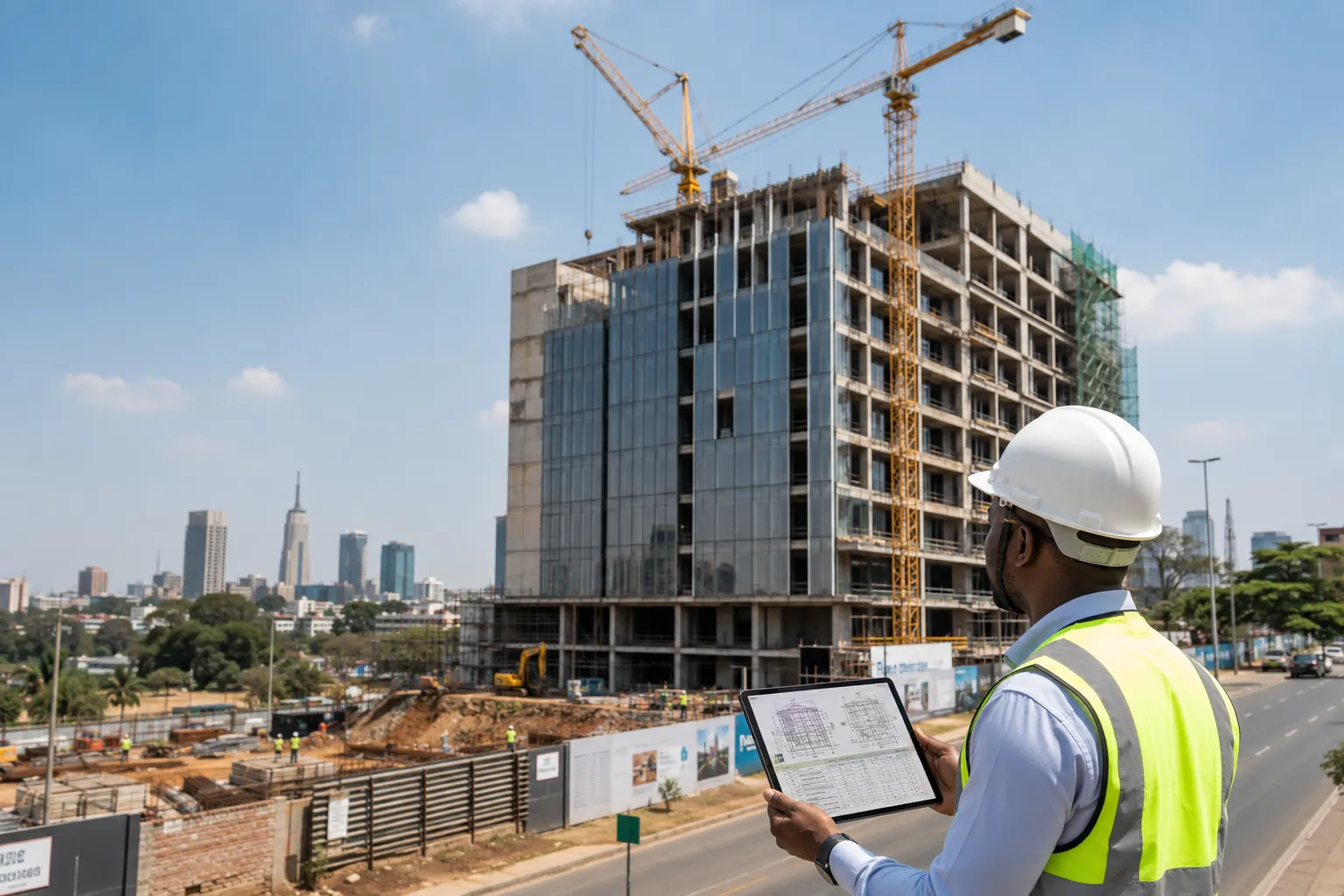
Building a commercial office block in Nairobi in 2026 is a significant capital commitment - typically running from KES 65,000 to KES 180,000 per square metre of gross floor area, depending on specification, location, and scope. Get this number wrong at the feasibility stage and you risk an underfunded project, a stalled development, or a completed building that cannot generate the returns needed to service the investment. This guide gives developers, investors, project managers, and architects a realistic, current breakdown of what office block construction actually costs in Nairobi today - and what drives that number up or down.
What Is Driving Office Construction Costs in Nairobi in 2026?
Nairobi's construction cost environment has shifted materially over the past three years. Several structural factors are pushing costs higher across all categories of commercial office development:
- Currency pressure on imported materials - Steel, aluminium, glass curtain walling, elevators, and MEP plant components are priced in USD or EUR. The depreciation of the Kenya Shilling since 2022 has materially increased the landed cost of these materials, with only partial recovery in 2024.
- Fuel and logistics costs - Cement, aggregates, and construction equipment movement costs are sensitive to diesel prices. Fuel price volatility continues to feed through into concrete, earthworks, and plant hire costs.
- Labour cost increases - Skilled construction trades in Nairobi are increasingly competitive. Demand from multiple large-scale infrastructure and commercial projects has tightened the supply of experienced engineers, foremen, and specialist subcontractors.
- Regulatory compliance costs - NCA registration requirements, Environmental Impact Assessment (EIA) obligations, fire safety compliance, and structural peer review all add legitimate costs that were historically underestimated or excluded from budgets.
- Specification creep - The Nairobi office market is increasingly competitive. Grade A developers are specifying higher-quality lobbies, smart building systems, and energy-efficient facades than were standard five years ago, pushing average fit-out costs upward.
Office Block Cost Tiers: What Are You Building?
The most important factor in any office block cost estimate is the specification tier - the level of quality and finish you are targeting. Nairobi's commercial office market broadly falls into three tiers:
Basic commercial office. Concrete frame, standard tiles, split-unit air conditioning, minimal lobby finish. Suitable for SMEs, government tenants, or owner-occupation in secondary locations.
Improved lobby, central VRF or chiller-based A/C, structured cabling, passenger lifts, raised access flooring. The dominant specification for Nairobi suburban office parks.
Curtain wall glazing, BMS integration, CCTV, access control, feature lobby with imported stone, green building measures. Targets multinationals, banks, and top-tier corporates in Upper Hill, Westlands, or Riverside.
Detailed Cost Breakdown: Office Block Construction in Nairobi 2026
Office block construction costs are most usefully understood as a sum of distinct elemental categories. The table below provides a 2026 cost range per gross square metre for each element, based on mid-market Grade B office specification in Nairobi:
| Cost Element | Grade C (KES/m²) | Grade B (KES/m²) | Grade A (KES/m²) | Notes |
|---|---|---|---|---|
| Substructure & Foundations | 6,000–9,000 | 8,000–14,000 | 12,000–20,000 | Highly site-specific. Expansive soils or rock in Westlands/Kilimani can increase foundation costs significantly. Piled foundations add KES 8,000–15,000/m² above strip/pad. |
| Structural Frame (RC) | 12,000–18,000 | 16,000–24,000 | 20,000–32,000 | Reinforced concrete frame with post-tensioned flat slabs common for Grade B+. Structural steel frames (for longer spans in Grade A) carry a 15-25% premium over RC. |
| Envelope (External Walls, Roof, Glazing) | 8,000–14,000 | 14,000–24,000 | 25,000–45,000 | The largest swing factor between grades. Curtain wall glazing systems (Grade A) are predominantly imported and priced in USD, making them acutely sensitive to exchange rates. |
| Internal Partitions & Doors | 3,500–5,500 | 5,000–9,000 | 8,000–15,000 | Shell-and-core delivery (partitions omitted) reduces cost but requires a tenant fit-out allowance. Most Grade A offices in Nairobi are delivered shell and core. |
| Finishes (Floors, Ceilings, Walls) | 4,000–7,000 | 7,000–13,000 | 12,000–22,000 | Raised access flooring, suspended grid ceilings, and feature lobbies in Grade A. Polished screed or tiles in Grade B. Basic paint and floor tiles in Grade C. |
| Mechanical (HVAC, Plumbing, Fire) | 6,000–9,000 | 9,000–16,000 | 15,000–25,000 | Central chiller plants and VRF systems for Grade B/A. Split units in Grade C. Fire suppression (sprinkler) required by NCA for buildings above 3 storeys. |
| Electrical (LV, Lighting, UPS, Generator) | 5,500–8,000 | 8,000–14,000 | 13,000–22,000 | Generator backup is not optional for any Nairobi commercial office. Structured data cabling, BMS, and smart metering add materially in Grade A. |
| Lifts & Vertical Transportation | 1,500–3,500 | 3,000–6,000 | 5,500–10,000 | Lift cost spread over GFA depends heavily on building height. A single passenger lift may cost KES 6M–12M installed - significant for a 4-storey building but marginal for 12 storeys. |
| External Works, Parking & Landscaping | 2,500–4,500 | 4,000–8,000 | 6,500–14,000 | Basement parking adds KES 20,000–35,000 per parking bay and is a major cost driver for Upper Hill and Westlands sites with NCA minimum parking ratios. |
| Professional Fees (Arch, Struct, QS, PM) | 5–8% of build cost | 6–10% | 8–12% | Includes architect, structural engineer, MEP engineer, quantity surveyor, project manager, and NCA approval fees. Often underbudgeted by first-time developers. |
| Contingency | 5–7.5% | 7.5–10% | 10–15% | Higher for complex Grade A projects with imported materials, longer programmes, and more interfaces between specialist subcontractors. |
Cost Per Square Metre by Nairobi Location
Where you build in Nairobi also influences your construction cost - not because concrete or steel costs differently per se, but because of logistics, subsoil conditions, existing infrastructure, and the specification expectations of tenants in each sub-market.
| Nairobi Sub-Market | Typical Office Grade | Indicative Build Cost (KES/m²) | Key Cost Considerations |
|---|---|---|---|
| Upper Hill | Grade A / B+ | 130,000 – 180,000 | Basement parking requirements, rocky subsoil in parts, prestige lobby expected by tenants, congested logistics |
| Westlands / Riverside | Grade A / B | 120,000 – 175,000 | Premium finishes expected; black cotton soils in some zones increase foundation cost; high generator reliability requirement |
| Kilimani / Kileleshwa | Grade B / B+ | 95,000 – 135,000 | Mixed residential/commercial zone; planning requirements can influence design; good SME and NGO tenant market |
| Industrial Area / Mombasa Road | Grade B / C | 70,000 – 100,000 | Lower land cost; functional specification; logistics and warehousing tenants; simpler planning environment |
| Thika Road / Ruiru | Grade C / B | 65,000 – 95,000 | Lower labour and logistics cost; growing light industrial and office market; less mature tenant base for Grade A product |
| Gigiri / Runda | Grade A | 140,000 – 185,000 | Diplomatic and international NGO market; highest security and specification requirements; lower density but demanding quality standards |
Key Cost Drivers Developers Often Underestimate
In our experience working on corporate construction projects across Kenya, the following items consistently appear as budget surprises for developers - particularly those building their first commercial office project in Nairobi:
1. NCA Compliance and Statutory Approvals
Nairobi City County building approvals, NCA project registration, structural peer review (mandatory for buildings above G+4), fire clearance from the County Fire Department, and EIA for larger developments all carry real cost and time implications. Budget KES 500,000 – KES 3,000,000+ depending on project scale, and allow 3–9 months in programme for approvals. For more on regulatory requirements, visit the National Construction Authority (NCA).
2. Generator and Electrical Infrastructure
Reliable power backup is non-negotiable for any Nairobi office block that expects to attract commercial tenants. A 500kVA-1MVA standby generator, automatic transfer switch, fuel storage, and associated LV infrastructure can cost KES 8M-20M+ depending on building size. This is frequently underbudgeted in initial project appraisals.
3. Borehole and Water Infrastructure
Nairobi Water Company supply to commercial premises is unreliable. Most Grade B and above office blocks in Nairobi require a borehole (KES 1.5M–3.5M including pump and casing), a storage tank system (KES 800,000 – KES 2.5M), and water treatment (KES 400,000 – KES 1.2M) as standard infrastructure. This is not optional - it is what tenants expect.
4. Basement and Structured Parking
NCA and Nairobi City County planning regulations specify minimum parking ratios for commercial office use (typically 1 bay per 25–50m² NLA). In central locations where surface parking is impossible, basement parking becomes mandatory. Each basement level adds significantly to the cost - typically KES 25,000–40,000 per m² of basement slab, plus excavation, retaining walls, waterproofing, and ramp construction.
5. Telecoms and Data Infrastructure
Grade B and above tenants expect redundant fibre connectivity, structured cabling to each floor, dedicated server rooms with UPS, and CCTV and access control. These systems - often contracted to specialist ICT subcontractors - are frequently excluded from the main contract and added as a provisional sum, only for the actual cost to exceed the allowance substantially.
Sample Budget: 6-Storey Grade B Office Block in Kilimani (2026)
The following is an indicative budget for a typical mid-market 6-storey Grade B office development in the Kilimani/Kileleshwa corridor, with approximately 3,000m² gross floor area across a ground plus five upper floor configuration.
| Item | Basis | Indicative Cost (KES) |
|---|---|---|
| Substructure & Foundations | 3,000m² @ KES 10,000/m² | 30,000,000 |
| Structural Frame (RC) | 3,000m² @ KES 20,000/m² | 60,000,000 |
| Envelope (Walls, Roof, Glazing) | 3,000m² @ KES 18,000/m² | 54,000,000 |
| Internal Finishes & Partitions | 3,000m² @ KES 15,000/m² | 45,000,000 |
| Mechanical Services (HVAC, Plumbing, Fire) | 3,000m² @ KES 13,000/m² | 39,000,000 |
| Electrical (LV, Lighting, Generator, Data) | 3,000m² @ KES 14,000/m² | 42,000,000 |
| Lifts (2 x passenger lifts) | Lump sum | 16,000,000 |
| External Works, Parking, Landscaping | Lump sum | 14,000,000 |
| Water Infrastructure (Borehole, Tanks) | Lump sum | 6,000,000 |
| Construction Subtotal | 306,000,000 | |
| Professional Fees (8% of construction) | 24,480,000 | |
| Statutory Approvals & NCA Fees | Lump sum | 2,500,000 |
| Contingency (8%) | 24,480,000 | |
| Total Project Budget (ex-land, ex-finance) | approx. KES 102,000/m² GFA | ~357,000,000 |
How to Keep Your Office Block Budget on Track
Budget overruns on Nairobi commercial office projects are common - but they are not inevitable. The following disciplines separate projects that deliver on budget from those that do not:
- Appoint a Quantity Surveyor at feasibility stage, not after design. A QS who only sees the project at tender stage cannot influence the fundamental design decisions that drive cost. Appoint one at brief stage and use elemental cost planning throughout design development.
- Fix your specification before going to tender. Scope changes after contractor appointment are the single biggest source of cost growth. If your architect is still designing during construction, expect significant variation orders.
- Use a Bill of Quantities (BoQ) for tendering. Lump-sum tenders without BoQ make variation pricing opaque and disputes expensive. Priced BoQs give you a transparent basis for cost control throughout construction.
- Carry a real contingency - and protect it. A 10% contingency that gets raided for scope additions in the first month of construction is not a contingency. Ring-fence it for genuine risk events.
- Choose your contractor on quality and track record, not price alone. The cheapest tender on a Nairobi office block is frequently the most expensive project outcome. Verify contractor NCA registration, recent comparable projects, and financial standing before appointment.
Frequently Asked Questions
How much does it cost to build a 4-storey office block in Nairobi in 2026?
A 4-storey Grade B office block in Nairobi with approximately 1,500-2,000m² GFA would typically cost between KES 130M and KES 220M in total project budget (excluding land and finance), equating to roughly KES 90,000-120,000 per gross m². The exact figure depends heavily on location, subsoil conditions, specification, and market conditions at the time of procurement. Engage a quantity surveyor for a project-specific estimate based on your brief and site.
What is the cost per square metre to build an office in Nairobi in 2026?
The all-in construction cost per gross square metre for Nairobi office buildings in 2026 ranges from approximately KES 65,000/m² for Grade C functional office up to KES 180,000/m² for Grade A prime specification. The most common mid-market Grade B suburban office falls in the KES 90,000-130,000/m² range for construction cost. When professional fees (8-10%) and contingency (8-10%) are added, total project costs are typically 18-22% above the base construction figure.
Does office construction cost include fit-out in Kenya?
It depends on the delivery approach. Many Grade A and Grade B+ office projects in Nairobi are delivered shell and core - meaning the structural frame, envelope, core services, and common areas are completed by the developer, but individual floor fit-out (partitions, finishes, tenant-specific services) is carried out by the tenant. Fully fitted office projects, where the developer completes all internal fit-out to a standard specification, are more common in Grade C and B builds for owner-occupation or single-tenant developments.
How long does it take to build a commercial office block in Nairobi?
A typical 4-6 storey office block in Nairobi takes 18-30 months from groundbreaking to practical completion, depending on complexity and contractor performance. Add 3-9 months for planning and approval processes before construction begins. Total development timeline from site acquisition to building handover is typically 2.5-4 years for a mid-market project. Taller or more complex Grade A buildings can take 36-48 months in construction alone. Programme planning should account for Kenya's two rainy seasons (March-May and October-December), which regularly delay outdoor works.
Is it cheaper to build or buy an office block in Nairobi?
This depends primarily on location and the quality of available stock. In Upper Hill and Westlands, Grade A completed office space currently transacts at KES 120,000-180,000 per m² of NLA - broadly comparable to or above new build cost on a per-NLA basis, meaning building from scratch can offer value where suitable land is available. However, acquiring an existing building provides immediate income, avoids construction risk, and eliminates the 2.5-4 year development period. A pre-construction cost and feasibility study from an experienced contractor will clarify the economics for your specific situation.
What percentage of construction cost should I allow for professional fees in Kenya?
For a Nairobi commercial office project, budget 8-12% of construction cost for professional fees covering architecture, structural engineering, MEP engineering, quantity surveying, and project management. NCA project registration fees, structural peer review costs, EIA preparation and approval, and County building approval fees are separate statutory costs that should be budgeted in addition, typically KES 1.5M-4M depending on project scale.
Planning an Office Block Development in Nairobi?
Our Corporate Construction team works with developers and investors from feasibility through to completion - providing accurate pre-construction cost advice, procurement support, and full construction delivery across Kenya.
Talk to Our Corporate Construction Team