

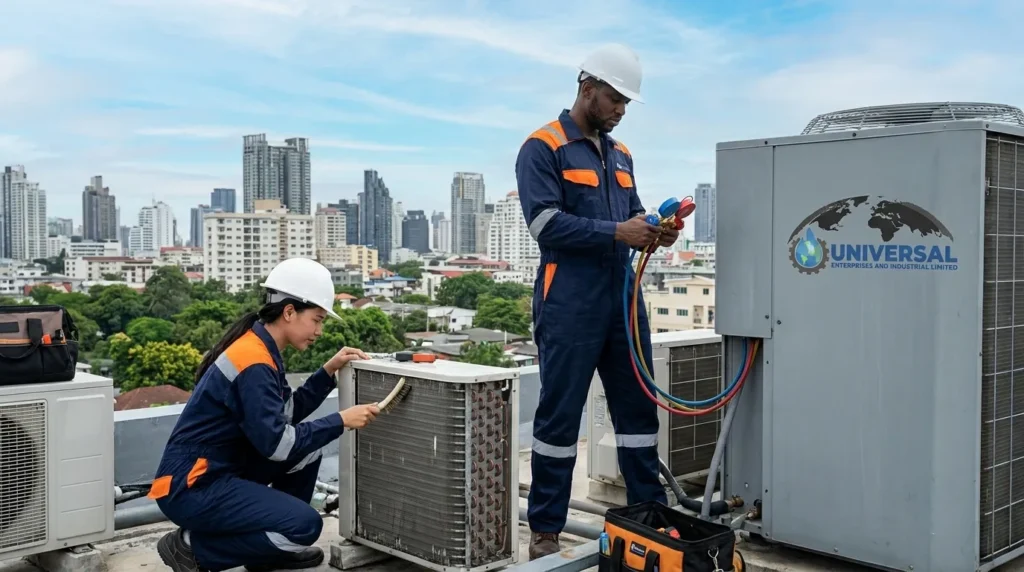
HVAC Maintenance Checklist for Large Buildings in Kenya
A HVAC system that nobody is properly maintaining is not a system quietly doing its job. It is a system quietly becoming expensive. Dirty coils force the compressor to work harder and draw more power from KPLC. Clogged filters degrade indoor air quality while reducing airflow efficiency. Refrigerant that slowly leaks goes undetected until the unit stops cooling altogether, usually at the worst possible time, in the middle of a Nairobi heatwave or the height of Mombasa's humid season.
For institutions and large buildings in Kenya, HVAC systems represent the single largest energy cost line item and one of the largest sources of unplanned maintenance expenditure. This guide gives facilities managers, property owners, and building supervisors a practical, Kenya-specific seasonal maintenance checklist, a clear picture of what things cost when they go wrong versus what preventive maintenance costs, and the key warning signs that should trigger an immediate call to a certified HVAC technician.
Understanding Kenya's Four Seasons and Their HVAC Impact
Unlike countries with clearly defined hot and cold seasons, Kenya's climate follows a four-period cycle driven by rainfall patterns rather than temperature extremes. Each period places different demands on HVAC systems, and a maintenance schedule that ignores this cycle will either over-service the system at low-stress periods or under-service it heading into peak demand.
Long Rains
March to May. High humidity, lower temperatures. Peak mould and condensate risk. Drain lines and drainage trays must be clear.
Cool Dry Season
June to September. Lower humidity, cooler nights. Ideal window for coil cleaning, refrigerant checks, and duct inspection.
Short Rains
October to November. High humidity returns. Pre-season service before this period prevents breakdowns during occupancy peaks.
Hot Dry Season
December to February. Highest cooling demand of the year, especially in Nairobi and coastal Kenya. System must be fully serviced before this period begins.
Common HVAC System Types in Kenyan Institutions
The maintenance requirements and service intervals vary depending on the type of HVAC system installed. Here are the systems most commonly found in Kenyan schools, hospitals, corporate offices, and large commercial buildings.
Split Air Conditioning Units
The most common system in Kenyan offices and institutional spaces. Indoor and outdoor units connected by refrigerant lines. Most manageable maintenance profile.
Service every 3 monthsDucted / Central Air Systems
Found in hotels, hospitals, and large corporate HQs. Single outdoor unit serving multiple rooms via ductwork. Duct condition is critical to efficiency.
Service every 3–6 monthsVRF / VRV Systems
Variable Refrigerant Flow systems are increasingly common in large institutional buildings. Complex multi-zone systems requiring specialist technicians familiar with the brand's controller software.
Service every 3 months; annual deep-serviceMechanical Ventilation Systems
Dedicated ventilation fans, air handling units, and extract systems in kitchens, laboratories, theatres, and server rooms. Fan belt condition and filter loading are the key maintenance items.
Inspect monthly; service every 6 monthsChiller Systems
Found in large hospitals, universities, and high-rise commercial buildings. Central chillers circulate chilled water to fan coil units throughout the building. Water quality and heat exchanger condition are critical.
Monthly checks; full service biannuallyPrecision Cooling (Data Centres)
Server rooms, laboratories, and financial sector data centres require precise temperature and humidity control. Redundancy checking and continuous monitoring are non-negotiable.
Monthly inspection minimumThe Full Seasonal HVAC Maintenance Checklist
This checklist is structured by frequency rather than by season, since the frequency of each task is determined by the system type and occupancy intensity of the building rather than the calendar month alone. Use it as the basis for your facilities management schedule and your service contract scope of work with your HVAC contractor.
Each checklist item is marked with a priority level: Critical (system failure risk or safety issue if skipped), High (significant efficiency or reliability impact), or Medium (important but lower immediate risk).
These checks can be carried out by a trained in-house facilities technician and do not require a specialist HVAC contractor. They take 30 to 60 minutes per unit for a standard split system.
- CriticalInspect and clean or replace air filters. In high-dust or high-occupancy Kenyan buildings (schools, hospitals, busy offices), filters load faster than manufacturers assume. A blocked filter reduces airflow, forces the system to overwork, and degrades indoor air quality significantly. Filter replacement costs KES 500 to KES 2,000 per unit.
- CriticalCheck condensate drain tray and drain line for blockage. In Kenya's high-humidity environment, blocked condensate drains are a leading cause of water damage to ceilings and walls. A clear drain takes two minutes to verify; a blocked one can cause thousands of shillings in ceiling damage overnight.
- HighVisually inspect indoor and outdoor units for physical damage, corrosion, or unusual vibration during operation. Coastal units (Mombasa, Malindi, Lamu) should receive particular attention for salt-related corrosion on condenser fins and cabinet paintwork.
- HighListen for unusual noises during operation: rattling, grinding, or hissing. Rattling often indicates a loose panel or fan blade. Grinding suggests bearing wear. Hissing is a potential indicator of refrigerant leak. Any of these warrant immediate investigation before the next scheduled service.
- MediumVerify that thermostat settings and timer programs are correct for current occupancy patterns. Unnecessary overnight or weekend cooling in unoccupied buildings is one of the most common sources of avoidable energy waste in Kenyan institutional buildings.
- MediumClear vegetation, debris, and obstacles from around outdoor condenser units. Nairobi's gardens and Mombasa's coastal vegetation grow quickly and can restrict airflow to the condenser, reducing efficiency and causing the system to operate at higher head pressures.
Quarterly servicing requires a qualified HVAC technician. In Kenya, quarterly service visits typically cost KES 5,000 to KES 10,000 per unit for split systems, or are covered under an annual maintenance contract. Schedule these visits to align with Kenya's seasonal transitions: before the long rains (February), after the long rains (June), before the short rains (September), and after the short rains (December).
- CriticalClean evaporator and condenser coils using industry-approved coil cleaning solutions. Dirty coils reduce heat exchange efficiency and force the compressor to work harder, increasing electricity consumption and compressor wear. Coil cleaning is the single highest-return maintenance task for energy savings in Kenyan commercial HVAC systems.
- CriticalCheck refrigerant pressure against manufacturer specifications using manifold gauges. Low refrigerant pressure indicates a leak and results in reduced cooling capacity and compressor stress. Refrigerant recharge costs KES 8,000 to KES 15,000; a failed compressor from operating on low refrigerant costs KES 25,000 to KES 60,000.
- HighInspect all electrical connections, contactors, and capacitors. Power quality in Kenya, including voltage surges and sags from KPLC supply, is a leading cause of electrical component failure in HVAC systems. Loose connections and deteriorated capacitors are inexpensive to address preventively and expensive after they cause a failure.
- HighTest and verify thermostat and control system calibration. A thermostat reading 2 degrees Celsius higher than actual room temperature will cause the system to cool longer than needed, adding directly to electricity costs.
- HighLubricate all moving parts including fan motors, bearings, and linkages where specified by the manufacturer. Inadequate lubrication is a primary cause of fan motor failure, particularly in high-humidity coastal environments where metal-on-metal surfaces corrode faster than inland.
- MediumInspect and clean condensate drain pans with a biocide solution to prevent algae and bacterial growth. In hospital and school environments, contaminated condensate drains are a significant source of Legionella and other airborne pathogens if left unaddressed.
- MediumCheck supply and return air temperatures at a representative sample of outlets. Significant deviation from expected temperature differentials indicates a system performance issue that warrants investigation before it causes a major breakdown.
Bi-annual service visits are the primary opportunity to carry out deeper inspection and remedial work. Schedule these in June or July and in October or November to align with Kenya's two major seasonal transitions. For ducted, VRF, and chiller systems, these visits are more involved and require specialist technicians.
- CriticalFull refrigerant leak detection across all accessible joints, service ports, and connections using electronic leak detection equipment. Even slow leaks of 100 to 200 grams per year will significantly degrade system performance over 12 to 18 months and eventually damage the compressor. R410A and R32 refrigerants also have significant global warming potential, making leak detection an environmental responsibility alongside a financial one.
- CriticalInspect and clean ductwork accessible sections for dust accumulation, mould growth, and physical damage. Duct cleaning in Kenya typically costs KES 12,000 to KES 25,000 for a complete commercial system. Heavily contaminated ductwork in hospitals and schools poses direct indoor air quality risks to occupants.
- HighTest all safety controls and protection devices including high-pressure cut-outs, low-pressure switches, and thermal overload protections. These devices are the last line of defence against compressor and system damage. A safety device that has been disconnected or bypassed by a previous technician is a liability waiting to become a claim.
- HighFor chiller systems, test cooling water quality including pH, dissolved oxygen, and hardness. Scale buildup of just 1 mm on chiller heat transfer surfaces increases fuel or electricity consumption by approximately 7%. Water treatment chemicals must be added and monitored on a defined schedule.
- HighInspect fan belts on belt-driven fans for wear, cracking, and tension. A snapped fan belt stops ventilation immediately and can cause heat buildup in enclosed plant rooms. Belt replacement costs KES 1,500 to KES 5,000; the cost of the consequences of a snapped belt in a hospital operating theatre or data centre are orders of magnitude higher.
- MediumReview energy consumption data against baseline. HVAC systems that are consuming significantly more energy than they did 12 months ago are experiencing performance degradation. This review requires access to energy metering data but is increasingly possible in larger Kenyan institutional buildings that have installed sub-meters as part of EPRA energy audit compliance.
The annual deep service is the most comprehensive visit of the year and should be scheduled during the cool dry season (June to September) when building cooling demand is lowest. This visit should be carried out by a certified HVAC engineer with specific expertise in the system brand and type installed. Annual maintenance contracts from reputable Kenyan HVAC companies typically cost KES 50,000 to KES 200,000 for a comprehensive commercial building service, depending on the number and type of units covered.
- CriticalFull system performance test against original design specifications. For large institutional systems, this should include airflow measurement at a representative sample of supply and return air outlets using a flow hood or vane anemometer, comparison to design CFM values, and identification of any zones with significant deviation indicating duct obstruction, damper failure, or filter overloading.
- CriticalDeep chemical clean of evaporator coils with foaming coil cleaner and full rinse. This is more thorough than the quarterly clean and addresses buildup in the deeper sections of the coil that routine cleaning does not fully reach. In Mombasa and coastal areas, salt deposits on condenser coils require an acid wash as part of the annual deep service to prevent progressive fin corrosion.
- HighFull electrical system inspection: thermographic scanning of electrical panels and contactors where equipment is available to identify hot spots indicating loose connections or overloaded circuits. Electrical faults are the second most common cause of HVAC system failure in Kenya after refrigerant-related issues, and they are directly linked to the quality of Kenya's grid power supply.
- HighFor VRF systems, download and review the system controller error logs for the preceding 12 months. Recurring fault codes that have been reset without investigation indicate underlying issues that will eventually cause a more serious failure. A trained VRF technician can identify patterns in the data that a routine site visit would miss.
- HighAssess the remaining service life of major components including compressors, fan motors, and heat exchangers. Compressors in Kenyan commercial systems operating at high ambient temperatures have an effective service life of 10 to 15 years with good maintenance. An engineer's assessment of component condition allows budget planning for major replacements before an unplanned failure disrupts building operations.
- MediumUpdate the system maintenance log and asset register with all service records, parts replaced, and refrigerant charges added. A complete service history is required for warranty claims, insurance purposes, and when selling or refinancing a commercial building. Missing service records are increasingly flagged in due diligence processes for commercial property transactions in Kenya.
HVAC Maintenance and Repair Costs in Kenya (2026)
The table below shows current 2025/2026 verified cost ranges for HVAC maintenance and repair services in Kenya, sourced from Bestcare Facilities Management, Easy Repair Nairobi, and Bestcare Fridge Repair. Mombasa and other towns outside Nairobi are typically 10 to 20% lower for labour but may carry higher parts costs due to distribution margins.
| Service | Cost Range (KES) | Notes |
|---|---|---|
| Basic maintenance visit (inspection and cleaning, split unit) | 5,000–10,000 | Per unit, per visit. Covers filter, coil clean, and operational check. |
| Air filter replacement | 500–2,000 | Standard filters. HEPA filters for hospitals and labs: up to KES 5,000. |
| Refrigerant recharge (R410A or R32) | 8,000–15,000 | Refrigerant gas: KES 1,000–2,500/kg. Most units need 1–2 kg for a full recharge. |
| Refrigerant leak detection and repair | 8,000–18,000 | Leak detection plus repair of identified leak point. Recharge additional. |
| Coil cleaning (evaporator and condenser) | 3,000–8,000 | Per unit. Deep chemical coil clean at annual service is higher. |
| Duct cleaning (full commercial system) | 12,000–25,000 | Depends on duct length and access. Hospitals and schools should prioritise this. |
| Compressor repair or replacement | 25,000–60,000 | Compressor unit: KES 15,000–35,000. High-end brands (Daikin, LG) up to KES 50,000. |
| PCB (control board) replacement | 8,000–25,000 | Inverter models are at the higher end of the range. |
| VRF system full service | 15,000–45,000 | Per service visit. Depends on system size and number of indoor units. |
| Emergency callout (after hours) | 10,000–20,000 | Callout fee only. Parts and repair costs additional. |
| Annual maintenance contract (commercial building) | 50,000–200,000 | Comprehensive yearly coverage including scheduled visits and priority response. |
Universal Innovations provides HVAC installation and maintenance services for institutions and large commercial buildings across Kenya. Explore our related services below:
Warning Signs Your HVAC System Needs Immediate Attention
These are the signals that should prompt an immediate call to a certified technician, not a note on the next scheduled service request. Ignoring them typically converts a small repair into a large one.
-
Insufficient cooling despite the unit running continuously The system is running but the space is not reaching the set temperature. Most commonly caused by low refrigerant due to a slow leak, severely dirty coils, or a failing compressor. Each of these will worsen rapidly if not addressed.
-
Water dripping or pooling from indoor units Indicates a blocked condensate drain, frozen evaporator coil, or a refrigerant issue. Water damage from an overflowing condensate tray can cause ceiling and electrical damage far more expensive than the HVAC repair itself.
-
Unusual noises: grinding, hissing, banging, or rattling Grinding points to bearing failure in a fan motor. Hissing suggests a refrigerant leak. Banging can indicate a loose or damaged fan blade. Rattling often means a loose panel or debris in the unit. None of these noises resolve themselves.
-
Sudden significant increase in electricity bills A degraded HVAC system draws more power for the same cooling output. An unexplained 15 to 20% rise in electricity consumption in a building where HVAC is the primary energy user is a reliable indicator of a system performance issue.
-
Frequent tripping of circuit breakers serving HVAC equipment Indicates an electrical fault within the system, most commonly a failing capacitor, short-circuit in the compressor windings, or an overloaded circuit. This is both an HVAC issue and a potential electrical safety issue. Do not simply reset the breaker and continue operating.
-
Mould, musty odours, or poor air quality complaints from occupants In an institutional building, this warrants immediate investigation. Possible causes include contaminated ductwork, a blocked and mould-colonised condensate drain, or a failed air handling unit filter. In hospitals, schools, and care facilities this is a direct occupant health risk.
-
Error codes or fault lights on the system controller Modern HVAC systems flag faults through error codes on the controller display. These codes should never simply be reset without first identifying and resolving the underlying fault. Repeated resetting without investigation masks a developing problem until it becomes a catastrophic failure.
Should You Sign an Annual HVAC Maintenance Contract?
For any institution or large building in Kenya with more than three HVAC units, an annual maintenance contract with a reputable certified HVAC company is almost always the right financial decision. Here is why:
A typical annual contract at KES 50,000 to KES 200,000 covers all scheduled preventive maintenance visits, priority response to breakdowns (typically 2 to 4 hours versus 24 to 48 hours for ad-hoc callouts), discounted parts rates, and a single point of accountability for system performance. Compare that to the alternative: four quarterly ad-hoc service visits at KES 8,000 to KES 10,000 each plus one or two emergency callouts at KES 10,000 to KES 20,000 each, plus the risk of a compressor failure at KES 25,000 to KES 60,000 that a well-maintained system would have avoided. The contract pays for itself in most years.
When evaluating contract providers, verify that the company employs EPRA-registered technicians for refrigerant handling (required by law for commercial systems using regulated refrigerants), holds appropriate insurance, and has demonstrable experience with your specific system brand and type. For VRF and chiller systems especially, brand-specific factory training is a meaningful differentiator in service quality.
Frequently Asked Questions
For commercial and institutional buildings in Kenya, split AC units should be serviced every three months given the country's year-round operation, high ambient temperatures, and dust levels. Ducted and VRF systems require the same quarterly frequency with a more detailed bi-annual deep service. Chiller systems require monthly monitoring checks and full bi-annual servicing. The minimum acceptable frequency for any commercial system is quarterly, and buildings in coastal Kenya or high-dust inland environments should lean toward the more frequent end of any recommended range.
A standard service visit from a reputable Kenyan HVAC contractor for a split system typically covers: filter cleaning or replacement, evaporator and condenser coil cleaning, condensate drain inspection and clearing, refrigerant pressure check, electrical connection inspection, thermostat calibration check, and a written service report. Some contractors include a refrigerant top-up within the visit fee; others charge separately. Clarify the scope in writing before confirming any service agreement.
Two factors drive higher electricity consumption during December to February. First, the higher ambient temperature reduces the efficiency of the outdoor condenser unit, requiring the compressor to work harder to reject heat. Second, if the system has not been serviced recently, accumulated coil dirt further degrades heat exchange efficiency. Both factors are compounded in a system running on low refrigerant. A system that has been properly serviced before the hot dry season will consume significantly less electricity for the same cooling output than one that has not been maintained.
A well-maintained commercial HVAC system in Kenya has an expected service life of 15 to 25 years. In practice, systems in Kenyan institutional buildings that are poorly maintained or operated without qualified technicians often fail within 8 to 12 years. The primary causes of premature failure in Kenya are operating on low refrigerant over extended periods (compressor damage), electrical faults caused by voltage surges from the KPLC grid that are not mitigated by surge protection, and condenser coil failure due to salt corrosion in coastal buildings that do not receive regular cleaning.
Yes. The Energy and Petroleum Regulatory Authority (EPRA) regulates refrigerant handling in Kenya. Technicians working with regulated refrigerants including R410A, R32, and R134a on commercial systems are required to be registered with EPRA and must use approved recovery equipment when removing refrigerant rather than venting it to atmosphere. When engaging any HVAC contractor for commercial work, ask to see their EPRA registration. Engaging an unregistered contractor for refrigerant work creates regulatory and environmental liability for the building owner.
The June to September cool dry season is the ideal window for major HVAC works including full system replacements, duct system upgrades, or chiller overhauls. Cooling demand is at its lowest during this period, meaning temporary system downtime has the least impact on building occupants. It is also the best time to carry out the annual deep service visit, as systems can be taken fully offline for thorough inspection and cleaning without complaints from building users. Avoid scheduling major HVAC works during December to February (hot dry season) or during peak exam periods for educational institutions.
Need HVAC Maintenance or Installation in Kenya?
Universal Innovations provides HVAC installation, preventive maintenance, and repair services for institutions, corporate buildings, and industrial facilities across Kenya. We work with certified technicians and offer structured annual maintenance contracts tailored to your building's system and occupancy profile.
Sources: Bestcare Facilities Management HVAC Services 2026; Easy Repair Nairobi HVAC Maintenance 2025; Bestcare Fridge Repair: AC Spare Parts Kenya 2025; Oxmaint HVAC Preventive Maintenance Guide 2026; BSM / Midea Air: HVAC Installation Kenya 2026; Fridge Repair Kenya: VRF System Maintenance. All costs indicative; obtain project-specific quotes before committing.
Company
Universal Innovations & Industrial Limited
Most Recent Posts
- All Post
- Building Design & Finishes
- civil engineering in Kenya
- Construction Insights & Tips
- Construction Works in Kenya
- Electrical Installations in Kenya
- Fuel Infrastructure Projects
- HVAC services in Kenya
- Industrial & Corporate Construction
- Industrial Fabrication & Welding

Explore Our Services
Universal Innovation & Industrial Ltd. delivers high-quality mechanical, civil, and electrical engineering solutions with a commitment to safety, innovation, and efficiency—explore our services to see how we can support your next project.
Company
Universal Innovations & Industrial Limited
Most Recent Posts
- All Post
- Building Design & Finishes
- civil engineering in Kenya
- Construction Insights & Tips
- Construction Works in Kenya
- Electrical Installations in Kenya
- Fuel Infrastructure Projects
- HVAC services in Kenya
- Industrial & Corporate Construction
- Industrial Fabrication & Welding
Explore Our Services
Universal Innovation & Industrial Ltd. delivers high-quality mechanical, civil, and electrical engineering solutions with a commitment to safety, innovation, and efficiency—explore our services to see how we can support your next project.