

Commercial Flooring Options in Kenya: What to Choose, What It Costs, and What Actually Lasts
You are about to spend real money on a floor that will either serve your building for 40 years or need replacing in five. This guide cuts through the noise: five flooring types, honest KSh costs for 2026, and a clear answer on which one fits your specific space.
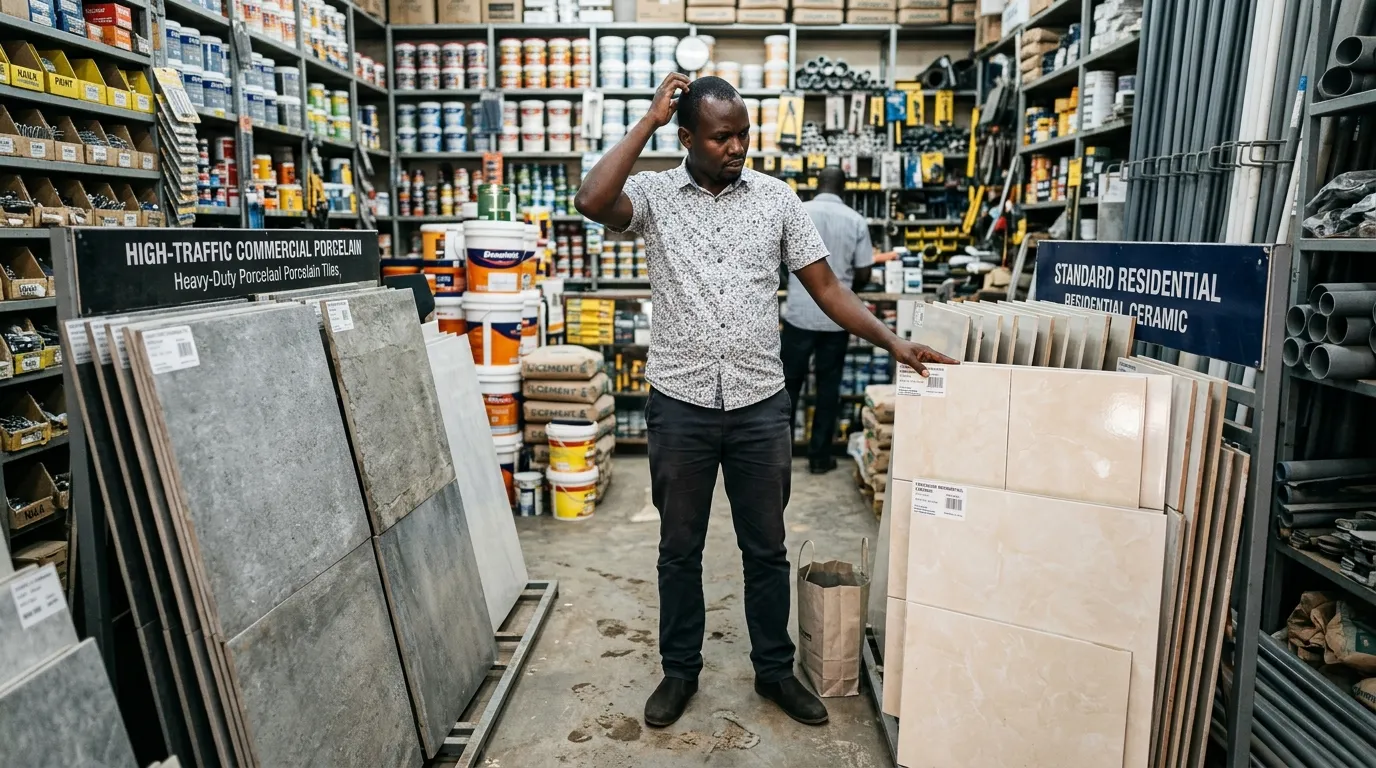
Walk into any busy Nairobi mall, hospital corridor, or factory floor and one thing is immediately clear: the floor takes a beating. It is not just a cosmetic decision. It directly affects your maintenance costs, your safety record, your operational downtime, and the first impression your facility makes on every person who walks in.
The problem we see on most sites across Kenya, Mombasa, Kisumu and beyond? Flooring decisions get rushed. The budget answer becomes the default answer. A few years later, floors are cracking, staining, peeling, or creating slip hazards — and the cost to fix them is far higher than a better upfront choice would have been.
So let us be direct about what the options are, what they cost, and when each one makes sense.
First: What Kind of Traffic Are You Actually Dealing With?
Before choosing a floor finish, be honest about what you are asking it to handle. The wrong starting question is "which floor looks best?" The right question is "what is this floor going to face every single day?"
Foot traffic volume matters — but so does the type of footwear. A corporate reception with a hundred visitors daily is different from a hospital with a hundred patients on trolleys and staff in hard-soled shoes. A supermarket floor faces trolley wheels, point loads from heavy items, and constant spillage.
Equipment and load is where most people underestimate. If you have forklifts, pallet jacks, or heavy machinery, you need a floor rated for compressive and abrasion loads. Standard tiles will not survive this environment no matter how good the installation is.
Moisture and chemical exposure changes everything. Kitchens, car washes, fuel station forecourts, and laboratories expose floors to water, grease, cleaning chemicals, and sometimes acids or oils. Only certain floor systems are built to handle that without degrading.
Hygiene requirements are non-negotiable in hospitals, food processing plants, and hospitality kitchens. You need a surface that can be properly disinfected — meaning no grout lines where bacteria accumulate and no porous surfaces that absorb spills.
With that context, here is what is available and viable for commercial use in Kenya right now.
The Five Commercial Flooring Options Worth Considering
Terrazzo Flooring
Terrazzo is one of the oldest commercial floor finishes in the world and it is having a genuine resurgence in Kenya's construction sector. You have seen it in older government buildings, good hospitals, and high-end malls. It is chips of marble, glass, or granite set into cement or epoxy resin, then ground and polished flat.
The case for terrazzo is simple: no grout lines. That one fact matters enormously in hospitals, schools, and food service environments. There is nowhere for bacteria, dust, or moisture to hide. The surface is completely seamless.
A properly installed terrazzo floor lasts 50 to 75 years. Annual maintenance is periodic polishing every three to five years, which costs roughly KES 400 to 800 per m² — a fraction of what replacement would cost. The upfront number looks high. Over a 30-year ownership period, terrazzo is almost always cheaper per year than the alternatives.
It also handles Kenya's climate well. No warping from humidity on the coast, no cracking from dryness in the highlands. You can do custom logos, patterns, borders — it is a design-forward floor, not just a practical one. Our related guide on whether terrazzo is really more expensive than tiles in Kenya covers the lifecycle numbers in detail.
| Terrazzo Type | Cost per m² (2026 est.) |
|---|---|
| Cement-based terrazzo | KES 3,500 – 6,000 |
| Epoxy terrazzo | KES 7,000 – 14,000 |
| Precast terrazzo tiles | KES 2,500 – 4,500 |
Epoxy Floor Coatings
Epoxy flooring is what you apply over an existing concrete slab. When properly done, it creates a seamless, impermeable, chemical-resistant surface. It is the default choice for fuel station forecourts, auto workshops, food processing plants, warehouses, and parking bays in Kenya — and for good reason.
Chemical resistance is where epoxy wins. Fuel, oil, acids, industrial cleaning agents — properly specified epoxy handles all of it. The seamless surface also means it meets food safety and pharmaceutical compliance requirements where those apply.
For industrial loads, high-build epoxy systems handle forklifts and heavy machinery without cracking. You can add anti-slip aggregate broadcast for wet environments like car washes. For large industrial floor areas, epoxy is significantly cheaper than terrazzo while still delivering excellent performance.
The critical point with epoxy: substrate preparation is everything. Shot-blasting or diamond grinding the concrete before application is not optional — it is the difference between an epoxy floor that lasts 10 years and one that peels within two. Do not let anyone skip this step to save cost.
This is directly relevant for forecourt work. If you are building or renovating a fuel station, read our detailed guide on forecourt works and design standards in Kenya.
| Epoxy System | Cost per m² (2026 est.) |
|---|---|
| Basic 2-coat epoxy | KES 1,200 – 2,000 |
| Mid-build self-levelling | KES 2,500 – 4,000 |
| High-build industrial epoxy | KES 4,500 – 8,000 |
Ceramic and Porcelain Tiles
Tiles are the most widely specified commercial floor in Kenya. They are readily available, local contractors know them well, the range of styles is huge, and the upfront cost is accessible. All of that is true.
But it is worth being honest about where tiles fall short in genuinely high-traffic commercial environments.
Grout lines are the main problem. Grout is porous. It stains. It collects bacteria. It is difficult to keep clean in heavy-use spaces, even with epoxy grout. For hospitals or food production environments, this is a real hygiene risk, not a cosmetic issue.
Chipping and cracking happen under point loads — dropped equipment, trolley impacts, anything concentrated on a small area. Standard ceramic tiles are particularly vulnerable. Porcelain is harder but not immune.
Slip hazard is serious on polished tiles when wet. Non-slip treatments dull the finish and need to be reapplied.
For moderate-traffic commercial spaces — offices, restaurants, retail counters, hotel corridors away from the main entrance — tiles remain a solid and cost-effective choice. For genuine high-traffic or industrial environments, they are not the right answer. See our full terrazzo vs ceramic tiles comparison and the tiles vs terrazzo guide for Kenyan buildings for a deeper breakdown.
| Tile Type | Supply & Lay Cost per m² (2026 est.) |
|---|---|
| Standard ceramic tiles | KES 1,200 – 2,500 |
| Porcelain tiles (mid-range) | KES 2,500 – 5,000 |
| Large-format porcelain slabs | KES 6,000 – 12,000+ |
Polished Concrete
Polished concrete is gaining real traction in Kenya's modern commercial and retail builds, especially where an industrial or minimalist aesthetic is part of the brief. The existing concrete slab is ground, honed, and polished with diamond tooling, then sealed or densified.
The big appeal is the cost logic: if a quality concrete slab is already in place, the floor itself is the substrate. You are not buying a new floor system — you are finishing what is already there. That makes polished concrete genuinely cost-competitive for large-area industrial builds or open-plan commercial developments.
Once polished and sealed, the surface resists scuffs, stains, and impact well. Maintenance is dry mopping and occasional damp mopping — no waxing, no stripping. The reflective surface also reduces lighting requirements, which is a real operational saving in large warehouses.
The main risk is the existing slab. Cracks, uneven curing, contamination, or poor-quality original concrete will be revealed and amplified by polishing. Always have the slab assessed before specifying this finish. For large-scale industrial builds, this links directly to structural quality work — see our guidance on structural building works in Kenya.
| Finish Level | Cost per m² (2026 est.) |
|---|---|
| Basic honed finish | KES 800 – 1,500 |
| Mid-gloss polished | KES 1,800 – 3,500 |
| High-gloss with sealer | KES 3,500 – 6,000 |
Vinyl and LVT (Luxury Vinyl Tile / Plank)
Vinyl flooring — particularly luxury vinyl tile (LVT) — has improved dramatically in quality and is now used in serious commercial projects, including Kenya's growing healthcare and hospitality sectors. This is not the cheap sheet vinyl of 20 years ago.
The case for vinyl in the right setting is real. It has a slight resilience underfoot that reduces fatigue for staff standing for long hours — nurses, retail staff, kitchen teams. It handles moisture well, many systems are rated for wet areas, and LVT can convincingly replicate timber or stone aesthetics at a fraction of the cost of the real material.
Acoustic dampening is also a genuine advantage in multi-storey offices and healthcare settings, where foot noise on hard floors creates constant background disturbance.
The clear limits: vinyl is not for heavy industrial loads or outdoor areas, and it is vulnerable to sharp objects and very high temperatures. Do not specify it for a warehouse or a factory floor.
| Vinyl Type | Supply & Lay Cost per m² (2026 est.) |
|---|---|
| Standard commercial vinyl sheet | KES 1,800 – 3,000 |
| LVT click or glue-down | KES 3,500 – 7,000 |
| Heterogeneous safety flooring | KES 4,000 – 8,000 |
Side-by-Side Comparison: All Five Options
This is the summary view. Use it to narrow down, then read the relevant section above for the full picture.

Different flooring types serve different commercial environments. Match the spec to the actual use.
| Floor Type | Durability | Maintenance | Best Use Cases | Relative Cost |
|---|---|---|---|---|
| Terrazzo | 50+ years | Very low | Hospitals, malls, offices, schools | Medium–High upfront, lowest lifecycle |
| Epoxy Coating | 10–15 years | Very low | Warehouses, factories, fuel stations | Medium |
| Porcelain Tiles | 10–20 years | Medium | Offices, restaurants, retail | Low–Medium upfront |
| Polished Concrete | 20+ years | Low | Showrooms, industrial, open-plan | Low–Medium |
| Vinyl / LVT | 10–20 years | Low | Healthcare, schools, offices | Medium |
Five Things to Get Right Before You Commit
1. Think in lifecycle cost, not just tender price
A tile floor at KES 2,000 per m² that needs replacing in eight years costs more over 25 years than terrazzo at KES 5,000 per m² that lasts 50. Most procurement processes do not calculate this. Ask your contractor for a lifecycle cost comparison before the decision is made. If they cannot provide one, that tells you something.
2. Assess the substrate before specifying anything
The existing floor structure — its flatness, load capacity, moisture content, and condition — determines what can go on top of it. A good contractor will assess this before quoting. Skipping this step is how you end up with an epoxy floor that peels or tiles that crack within two years. For structural concerns, this is where civil engineering and renovation specialists need to be involved early.
3. Match the floor to the actual traffic — not what you imagine
Be specific. Pedestrian-only traffic, wheeled equipment, chemical exposure, and temperature cycling all stress floors in different ways. A warehouse that "might have forklifts occasionally" still needs an industrial-rated floor. Specifying to your optimistic scenario rather than your realistic one is a common and expensive mistake.
4. Work with specialists who have done it before
Terrazzo and high-build epoxy require skilled, experienced installation teams. Using a general contractor who has never laid terrazzo before, or a painter applying epoxy without proper surface preparation, will result in system failure regardless of product quality. Ask for completed project references and go see them in person. Our case studies — including work at HASS Nyali Phase 1 and the Nyali Phase 2 structural works — show the kind of detailed execution that commercial flooring demands.
5. Have a maintenance plan before the floor goes in
Every floor system requires some maintenance. What matters is knowing what it costs, how often it is needed, and who is going to do it. A terrazzo floor neglected for 15 years is still recoverable with professional polishing. An epoxy floor with cracks left unsealed will delaminate. Plan for maintenance from day one. For commercial buildings with multiple systems to maintain, our civil engineering and renovation team can advise on building-wide maintenance programmes.
Common Questions About Commercial Flooring in Kenya
Need a Floor That Will Still Look Good in 20 Years?
We work with developers, facility managers, and institutions across Kenya to specify and install commercial flooring that actually delivers. Tell us about your space and we will advise on the right system for your budget and use.
Get a Free Site Assessment